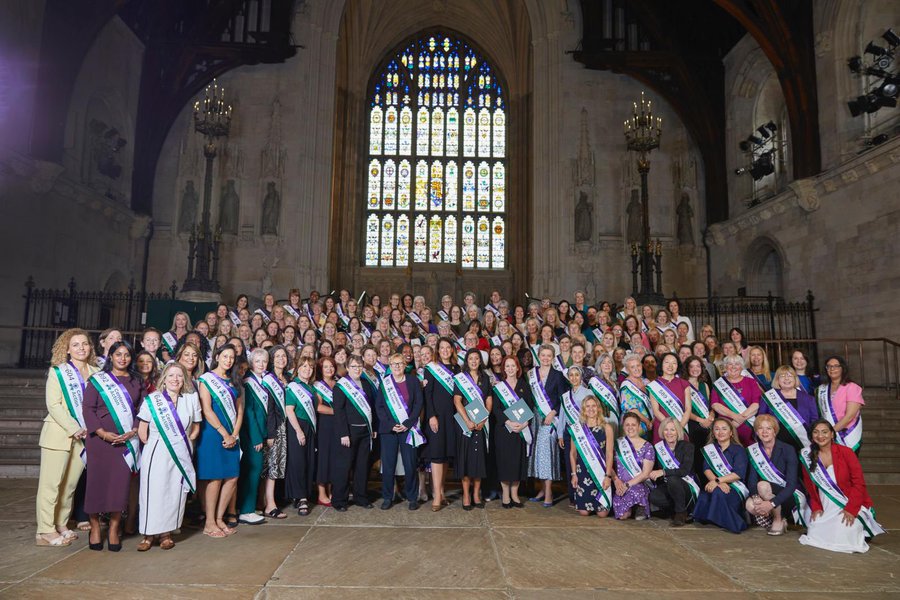
Narcissism can take many forms. Easy to recognise is the braggadocio and ‘I am the greatest’ postures of figures such as Donald Trump, but harder to spot is that which is wrapped in displays of virtuous victimhood and collective solidarity. Feminist displays of the sort shown above, it seems to me, fit the bill for communal narcissism. Why left leaning MPs should have been standing in solidarity with a virulently right wing organisation that was opposed to universal suffrage is a mystery to me. Some kind of suspension of rational judgement must also have been involved.
At first sight, communal narcissism is hard to define. It could become an easy catch-all like institutional racism or sexism. Does that mean when you take out all the individuals from an organisation, there is a core or an essence that is, say, racist? Perhaps communal narcissism is more that individuals can disguise their vanity, grandiosity and entitlement through their ‘selfless’ contributions to activist organisations. Both individual narcissists and the communal variety share the need to for affirmation and validation. That is not to say there are not well adjusted individuals finding quiet satisfaction advocating for social justice, but there are also those whose personal need for validation overshadows the cause for which they are ostensibly fighting and sometimes the organisation is a vehicle for their vanity and grandiosity. Furthermore, such organisations may attract like minded people and become corrupted in the process. Communal organisations can be a vehicle for narcissists to maintain their self image. In this regard, some organisations may be better than others. Charities and NGOs, for example, give rise to what some social scientists term ‘symbolic capital’- its members are seen to have moral and epistemic authority and that is why such people are over-represented in politics. In short, social justice organisations can be a means for narcissist to validate themselves and grow their power. It could be agued that communal narcissists differ from self centred narcissists in the means they employ for the same ends – boosting their self esteem and gaining power over others.
Musa Al-Gharbi puts it better than I can in his book ‘We Have Never Been Woke’ when he says …
‘However, symbolic capitalists are often quite willing to trade wealth for symbolic capital -especially if they are already relatively well off (or hail from relatively advantaged backgrounds). As a recent study in the American Sociological Review put it “, jobs that increase one’s moral standing with others or one’s moral self-image often function as a luxury good which higher paid workers are more willing to trade for as the urgency of pecuniary income recedes.”
A figure who springs to mind in writing this is Labour MP, Jess Phillips. She worked for the taxpayer funded ‘charity’ Women’s Aid before entering politics. At first sight, this may seem like a selfless act and perhaps it was, but such jobs that don’t lead to conventional careers can also be a marker of family wealth and, notwithstanding her faux working class act, that applies to Jess. Furthermore, they do bring with them the sort of social capital referred to above. Jess was able to leverage that capital to get a position in the Labour Party that she might not have been able to do had she pursued another more conventional and equally worthy career.
There is good evidence that vulnerable victimhood and activism can be associated with narcissism. Victimhood can be a good way of maintaining a grandiose self image because it excuses past failures and it gives the bearer a social status they would struggle to earn by other means. Victims are also assumed to have some kind of special authority. However, as long ago as 1943 Bertrand Russell saw through the dangers of this fallacy. In an essay entitled ‘The superior virtue of the oppressed’ he warned against the dangers of seeing victimhood, or supposed victimhood, as a badge of moral authority. Psychologists call this tendency to see victims this way as the ‘virtuous victimhood effect‘ and it is a pervasive cognitive bias and one that some narcisists are adept at exploiting.
Here, I am being speculative, but I wonder if female narcissism, on average, differs from the male variety. Perhaps the male variety is more Donald Trump and Andrew Tate style braggadocio, whereas the female type displays its grandiosity and entitlement in other ways; through supposedly selfless activism mediated through organisational structures and this type of narcissism is harder to recognise and is perhaps more pervasive.

 toxic feminism