The half-truths, repeated, authenticated themselves. Joan Didion
The ease with which feminists can implant questionable and sometimes overtly fabricated statistics into the narrative should be a cause for concern for everybody, male and female. It requires two things, a willingness to lie and dissemble, and a gullible media that does not examine far-fetched claims. What then follows, is reification through repetition, and a myth becomes established in the public consciousness.
The kind of dodgy statistics we encounter daily, are discussed under the following headings – Outright fabrications, statistics with systematic bias, statistics without context, categorising boys as children or even girls, only women asked- therefore only women affected and self-selected cohorts recruited through social media.
Outright fabrications
These are common and flourish because the media are so unwilling, or perhaps too lazy, to challenge feminist statistics. Take, for example, the claim that women are 14 times more likely to be casualties in natural disasters such as earthquakes and floods. It has been repeated without verification and authenticated itself. Good to see for once BBC’s excellent ‘More or Less’ challenging a feminist statistic and it turns out to be utter b******s. The pattern is mixed and there is a trend towards more men dying in economically developed countries and more women dying in less prosperous countries, but even there it does not even come close to the 14:1 figure. For an account of this dodgy statistic see BBC’s More or Less
Domestic abuse costs 66billion per year?
This statistic periodically crops up on social media. When challenged, posters are never able to produce the source and usually double down on the figure or resort to accusations of misogyny or ‘condoning rape culture’. The figure of 66 billion exceeds our total annual defence budget of £63 billion and far exceeds the entire policing budget of £17.6 billion. It is, in short, a fabrication.
A statistic that has been reproduced in the Guardian, The Independent and Laura Bates’s book ‘Men Who Hate Women’ is the claim that a man 230 times more likely to be the victim of rape than of a false rape accusation. A big part of the feminist project is to diminish the possibility of false rape accusations so that ‘due process’ can be done away with – the word of the victim should be sufficient, or so some feminists would have you believe. That being the case, this claim comes in handy. However, it is completely wrong. The low false allegation rate is based on police prosecutions for false allegation. The reason police very rarely prosecute this crime is for fear of having a dampening effect on other women coming forward. While this may be a good policy, it does mean we cannot rely on police prosecutions as a measure of the false allegation rate. The rate of false allegations (together with the number of true rapes that are not prosecuted) is probably unknowable. Rape is often a matter of one persons word against another with no witnesses. It would be as foolish to believe all women as it would be to believe all men.
Statistics With Systematic Bias
In this situation there may be some rigour in the collection of data and empirical methods may have been applied in some form. However, a systematic bias has been applied to the favour of women. A good example of this is the Global Gender Gap Index (GGGI) which is meant to benchmark gender parity across four key dimensions. It is supposed to track progress towards gender equality and from that statistic, we often hear claims, repeated in parliament, that at present rate it will take over a hundred years for women to achieve parity with men. This is entirely false.
Putting aside for a moment that the GGGI only focuses on issues highlighted by women’s rights organisations and ignores issues highlighted by men, the GGGI truncates scores that are favourable to women so a statistic can never reveal relative male disadvantage, only show male advantage. Let me illustrate. Equality is represented by 1 and a ratio of less than 1 indicates female disadvantage and above 1 female advantage. So what about ratios above 1 (and there are many)? Well, they are made to vanish by setting ratio back to 1. If that doesn’t make you angry it should. It represents the systematic rigging of statistics, to the disadvantage of men, by the World Economic Forum (WEF).
So what happens when you remove this truncation and score all issues fairly? The best evidence we have come from the Basic Index of Gender Inequality or BIGI see here. As you might expect, a different picture is revealed. In developing nations, you find relative female disadvantage though the picture is mixed, but in developed nations, the pattern that emerges is of consistent female advantage across the domains of life span, life satisfaction and education.

If you are not outraged by this statistical legerdemain, you should be.
Statistics without context
Probably this is the most common form of statistical manipulation. It is not outright lying but the aim is to leave an impression, by the exclusion of equivalent data for men and boys, that is at variance with reality.
Take, for example, Meghan Markle’s claim that the COVID-19 pandemic would tip 47 million women worldwide into poverty. A claim that was unthinkingly reproduced in several daily papers. The aim was, by the sin of omission, to imply that there was no problem for men and boys. However, reading the small print at UN Women, the same data source showed that 49 million men and boys would also be tipped into poverty. The relevant page at UN women has now been taken down but you can find the same data in a Spectator article- here.
Indeed, this tactic is a favourite of UN Women. When they tell you that 128 million girls are out of full-time education worldwide they neglect to tell you the 132 million boys are also out of education.
The aim in all of these cases is, by the sin of omission, to suggest the problem only affects girls.
Categorising boys as children or even girls
I was stunned by this definition of VAWG ‘as crime that disproportionately affects women and girls’ If you read the ‘Violence against Women and Girls code of Practice’ it states on page 4 that to be considered as VAWG..

We don’t apply this terminology to any other area of public life. The majority of homeless people are male but we don’t refer to them all as homeless men and subsume the needs of homeless women under a men’s strategy. The majority of suicide victims are male but quite properly, we don’t view female victims as men and subsume them under a men’s strategy. The current wording is frankly immoral.
Only ask women – therefore only women affected
A good example of this was the “women’s health let’s talk about survey’ of 2021. Even though men and women are both users of the National Health Service and contribute to the NHS through the taxes they pay. Only women were asked about their experiences with the NHS. This in turn spawned claims at the BBC that the NHS was misogynist and launched a slew of sloppy and poorly researched newspaper articles such as this one by Ian Hamilton writing in the Independent – here.

A survey that only looks at women’s experience of the NHS can not possibly answer the question of whether the NHS selectively under-serves women (misogyny), or serves both sexes equally badly. Of course, the promoters of the 2021 survey didn’t care about that.
Self selected cohorts recruited through social media
The dangers of extrapolating from self-selected cohorts particularly those recruited through social media are obvious. Those with an ‘axe to grind’ or who have had bad experiences are more likely to respond. There is also the problem that social media users are not representative of the general population. Twitter, for example, tends to attract a younger more activist audience. This does not stop people from making wild generalisations from such data. Take this headline from the BBC covered in my post ‘a tale of research misconduct and gullible hacks‘
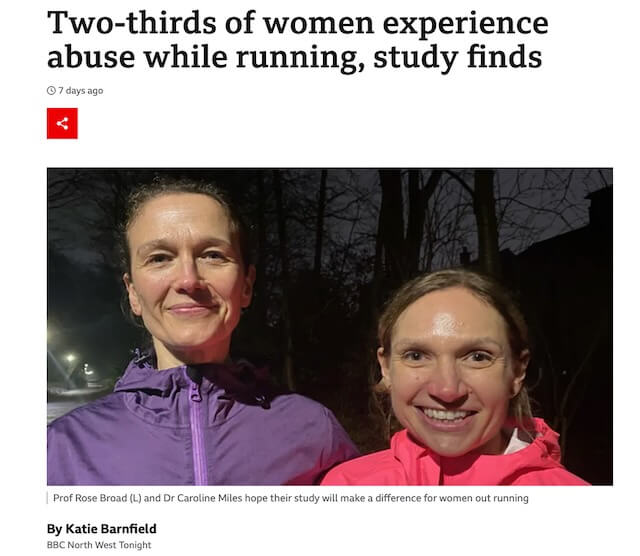

The problem was that the study population was recruited via twitter. To generalise from that study to the wider population was indefensible. Not only that, but a study that excluded men could not conclude that it was selectively women who were being abused – from my personal experience it certainly isn’t only women.
Conclusion
The feminist temple is built on statistical sand. Their enablers in the media have failed to challenge dodgy data and questionable research methods. It is time, for example, that BBC Verify adopted the same scepticism towards feminist statistics that it currently adopts to claims arising from political parties or the IDF.

 toxic feminism
Test
LikeLike
WordPress is rejecting comments, so I don’t know if I can post this, but thanks for the information.
LikeLiked by 1 person
Thanks for your comment which, I am pleased to say, wasn’t rejected.
LikeLike
wow!! 8Carol Vorderman
LikeLike