Male coping strategies can be adaptive, or to put it another way, ‘toxic masculinity’ can be good for you.
It is widely accepted, in the media at least, that suppressing thoughts is maladaptive and that the key to mental health and flourishing is to open up and share your feelings. It is also widely believed that men are more resistant to this process and it is claimed that this accounts for their higher suicide rates. What is missing from this simplistic worldview is evidence. Furthermore, nobody is asking the opposite question, do female coping stages lead to the higher rates of anxiety and depression that are found among women and girls?
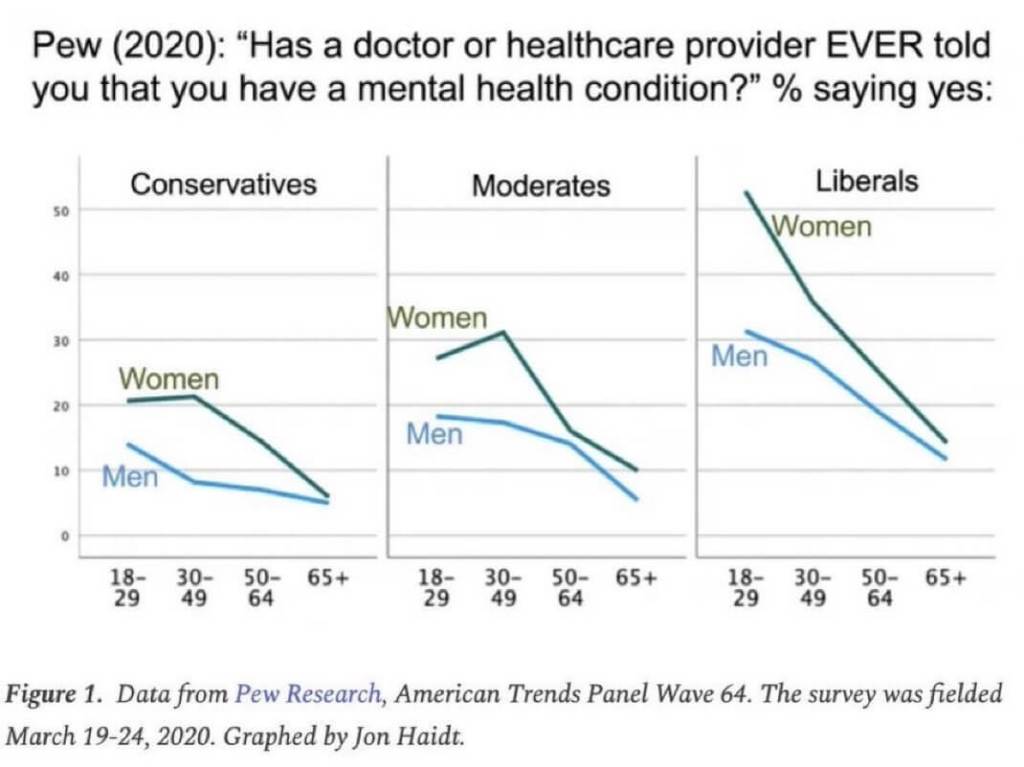
This mindset is also prevalent in academia. Male feminist Stephen Burrell, for example, has listed stoicism as a feature of toxic masculinity in his report on ‘Masculinities and COVID-19’ here. Without evidence, he even attributed mens higher death rate during the pandemic to that stoicism.
I have always been sceptical of this narrative. There is, after all, an ancient tradition of stoicism as a way of dealing with inevitable trauma and travails that are a part of life. This tradition discourages dwelling on misfortunes and resentments. Not only that, I have relatives who survived life’s traumas without recourse to what my grandmother would have termed ’emotional incontinence’. My great grandfather survived after ships he was serving on were torpedoed and sunk on two successive voyages during WW1. Again, during WW1, my grandfather had to be dug out of a trench that had collapsed following a shell hit. My father survived an assault on a hill top fortification in WW2. These people know a thing or two about coping with life’s traumas and their approach could best be described as stoical. Neither was this stoicism confined to the men. My great grandmother died in childbirth leaving my grandmother to be cared for a succession of relatives, she would have had little time for people wearing their victimhood, like a badge of honour. In this regard, I doubt if there was anything unusual about my family, there are countless similar stories to be heard.
A study published in Science Advances on September 23 (here) paints an interesting and nuanced story and one that conflicts with the popular narrative that suppressing uncomfortable thoughts can lead to a rebound with increased intensity of painful thoughts.
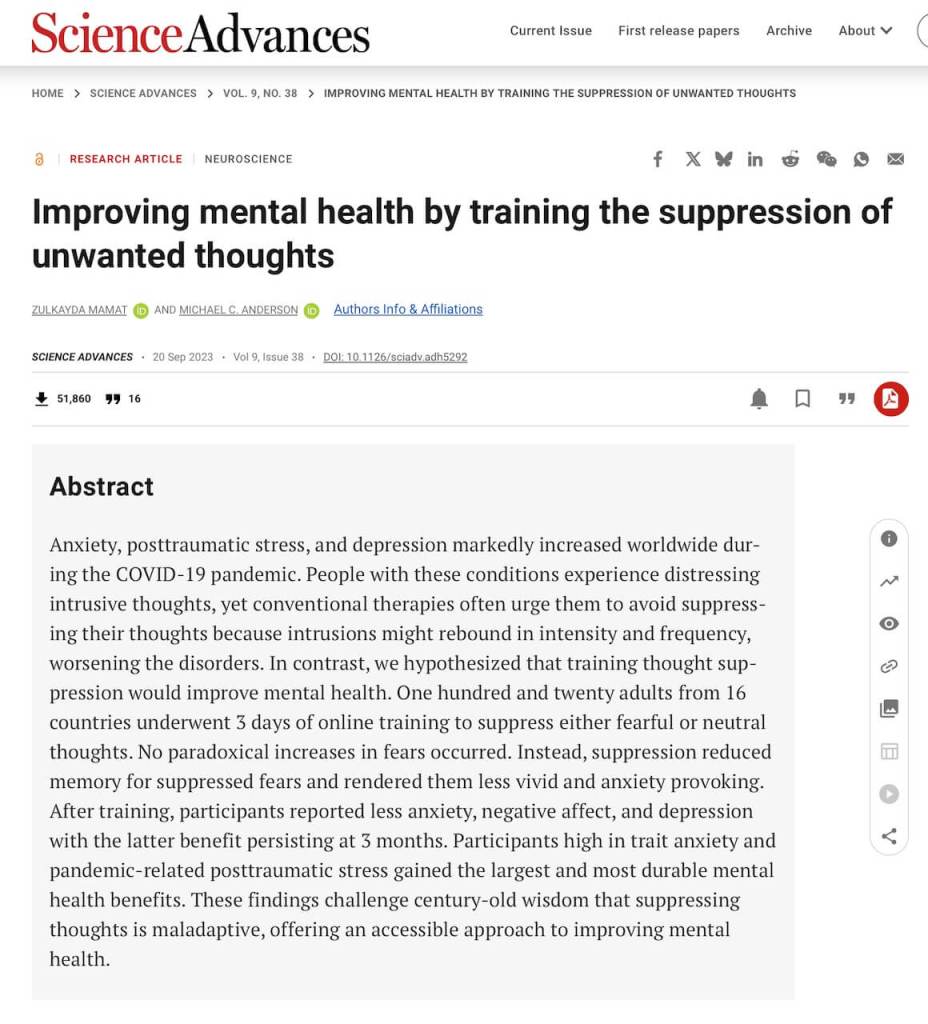
Researchers at the Medical Research Council (MRC) Cognition and Brain Sciences unit recruited 120 volunteers. Each participant was invited to think of scenarios, that were specific to them that might occur over the next twenty years. These scenarios had to be negative, such as a relative dying of COVID 19, neutral such as a visit to the opticians or positive, say one’s sister getting married. Subjects were also asked to provide a cue word that would evoke these scenarios.
Then, over 12 sessions participants were either invited to evoke these thoughts as vividly as possible in response to the cue word (imagine repetitions) or in ‘no imagine’ sessions participants were invited to dismiss the thoughts evoked by the cue words either by diversionary thinking or actively suppressing the negative thoughts.
It should come as no surprise, though it runs counter to modern wisdom, that those subjects who practiced actively suppressing negative thoughts found the emotions evoked by the cues much less troubling than those who were encouraged to evoke or confront the thoughts as vividly as possible. As someone put it to me, god gave you a subconscious to dump the bad stuff in and the best thing to do is just leave it there.
There is other research pointing in a similar direction (here). A meta-analysis of studies that examined the effect of self-reflection showed no benefit from self-reflection. Indeed, the model showed a significant positive relationship between self-reflection or rumination and overall negative mental health indicators, including depression and anxiety. In short, too much self-reflection was bad for you, and again, it is perhaps better to suppress negative thoughts.
What are seen as male vices may actually be protective and the higher suicide rate of men may not be accounted for by their coping strategies. There is at least a need for a more nuanced discussion. After all, nobody is blaming female coping strategies for their higher rates of anxiety and depression among women, and neither should they be.

 toxic feminism
femgoggles I am a 59 yr old lawyer in Canada. I studied economics and tax law. I have some interesting data on how feminism made women poorer in unpredictable ways that largely affected working class women. I’d love to share. Email me.
LikeLike