“When men stop believing in god, they don’t believe in nothing; they believe in anything” attributed to G K Chesterton.
Astrology, the belief that our personality and life trajectory can be influenced by the position of the planets at the time of our birth, is bunk. It has been debunked so often that belief in it tells us something about its proponents.
A good place to start is Colin Wright’s excellent substack Reality’s Last Stand (here). When astrologers were tested, they scored no better than chance in predicting personality features from their natal astrology chart. Furthermore, when ‘experienced’ astrologers were compared with their more ‘inexperienced’ colleagues there was no difference in their ability to predict personality, notwithstanding their belief that they would do better. Neither do astrologers agree with each other more than you would expect by chance alone. In short, they are not even consistent among themselves.
Despite this, and numerous other studies, belief in astrology is surprisingly common. Where it gets interesting, however, are the risk factors for a belief in the predictive powers of astrology? There are two useful studies looking at this issue here and here and they reach similar conclusions. The predictors for a belief in astrology are low intelligence, narcissism and (wait for it) gender. Women are more likely than their male peers to believe that an external locus of control, the position of the planets, influences their lives.
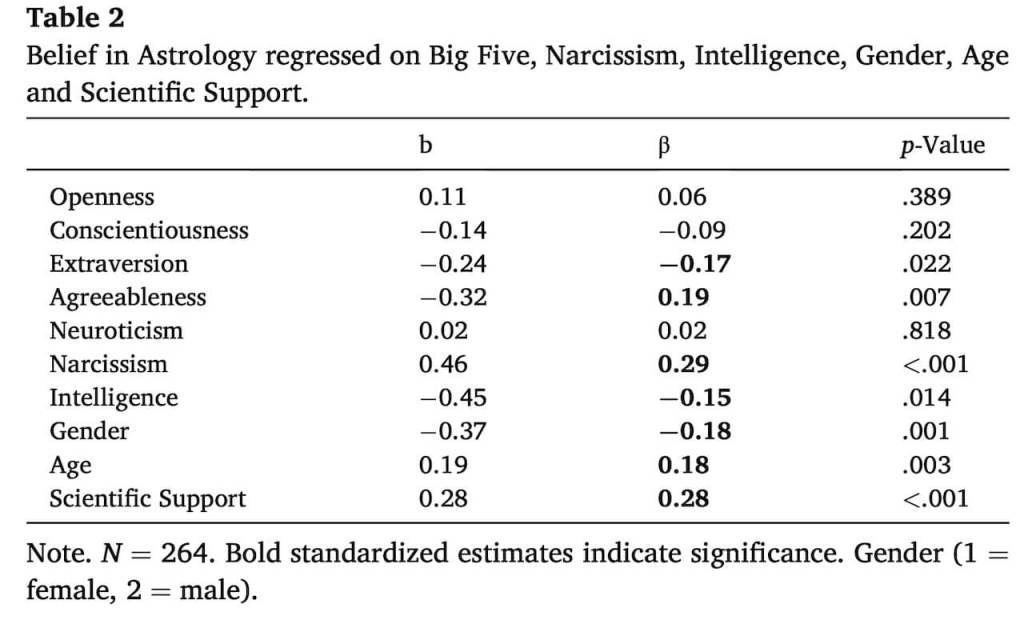
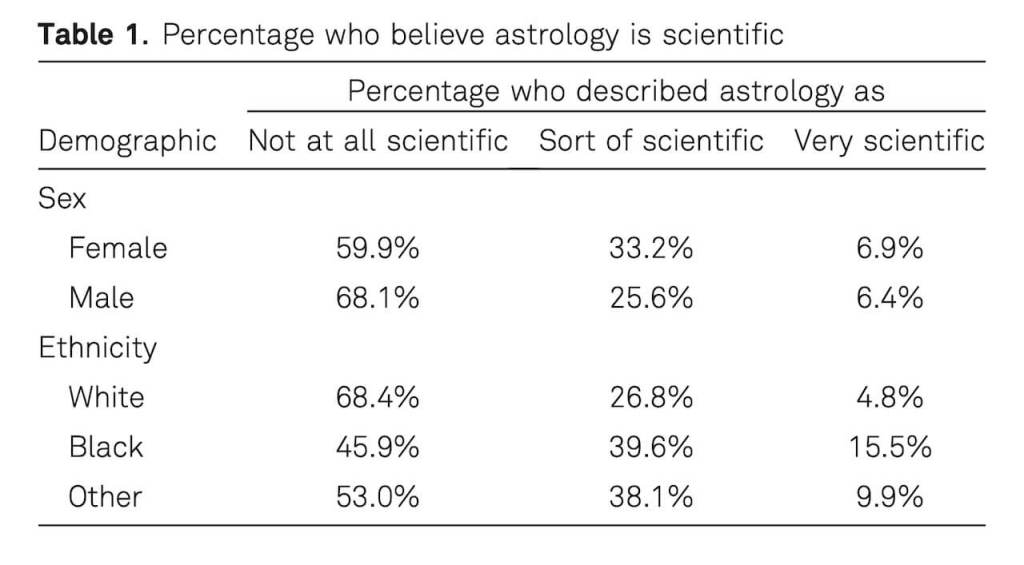
Also interesting to me is that this is a bit of a red flag for men in someone’s dating profile.
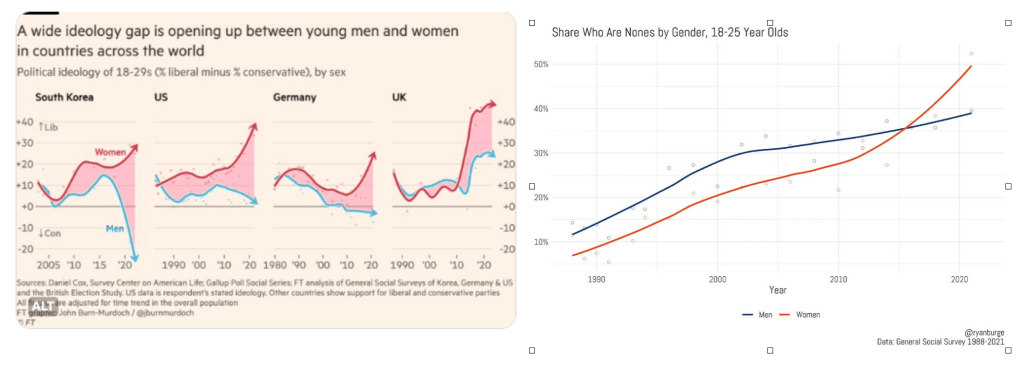
Another example of a belief in an external locus of control might be religion and, once again, women are more likely to affiliate with religious belief. Although this is more likely to be true in Judeo-Christian countries (here) it is still true even in Muslim countries. There are gender gaps in religious worship attendance in most cultures and women are more likely than men to report praying every day. This may be why women are more polarised than men on the subject of abortion (here). The most strongly opposed to liberal abortion laws are conservative-religious women.
That said, there is evidence of some recent change in religiosity among women in Western, educated, industrialised, rich and democratic (WEIRD) countries. However, I suspect this change reflects a move towards another quasi-religious belief system – Critical Social Justice (CSJ) in general and feminism in particular.
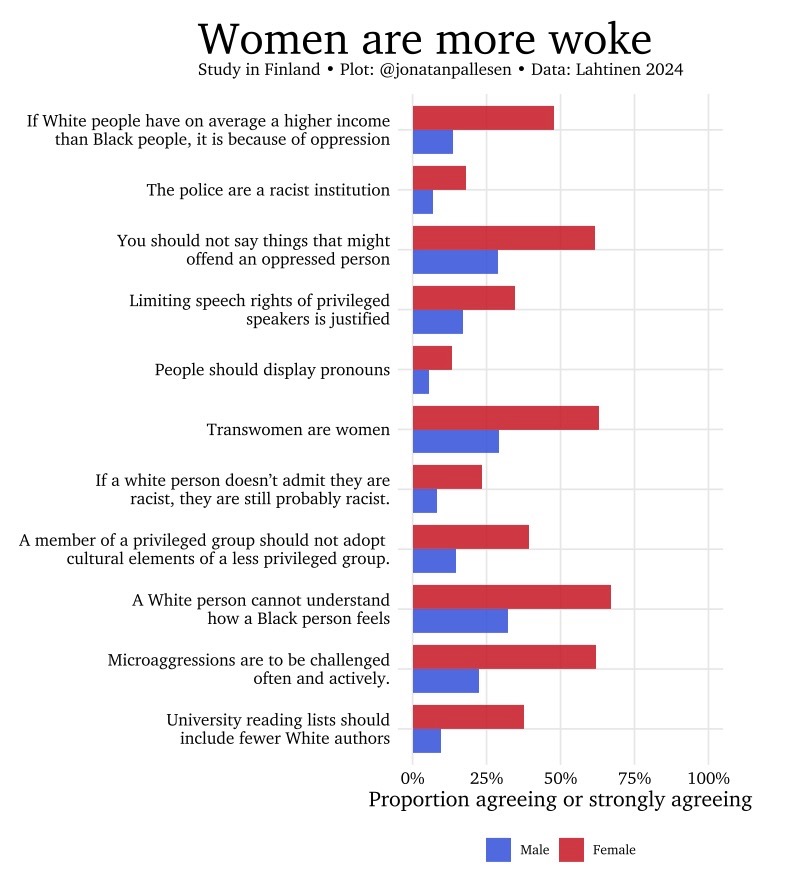
A key plank of CSJ ideology is a belief in invisible systems of power (or external loci of control) that permeate society like the Holy Ghost. These systems of power, according to CSJ advocates, include patriarchy, white supremacy and heteronormativity. Several studies have shown that these belief systems are more attractive to women than men and these differences are large (see here). As with astrology, for example, belief in these power systems also correlates with grandiosity and narcissism see here and here.
Indeed, Cory Clarke has argued that the rise of CSJ infused ideology in our university correlates and is perhaps caused by increased numbers of female ‘academics’ see here).
Janice Fiamengo goes further and makes a striking parallel between feminism and religion. I recommend you read her essay on substack here. Janice sums it up nicely when she says
Feminism is closer to a religion than a social science, concerned less with truth than belief, often impervious to reason, and highly intolerant of competing viewpoints. It may be allowed a carefully circumscribed place in the public sphere, but it should never have been allowed, as it has been, to operate as an unofficial state religion”
Perhaps those missing religious women have just jumped ship to a new ‘religion’. You can take these parallels further. Criticism of orthodox feminist liturgy is termed misogyny, the new blasphemy. Also, their religion even has a form of original sin – toxic masculinity.
One key difference between CSJ belief systems and orthodox religions is the effect they appear to be having on the happiness of their advocates. Whereas religious affiliation seems to be associated with better mental health, CSJ seems to have the opposite effect. The most unhappy group in society are young liberal women and I wonder if, at least in part, this is the burden imposed by their belief system. In short, the new religion doesn’t just harm men, it harms women too.
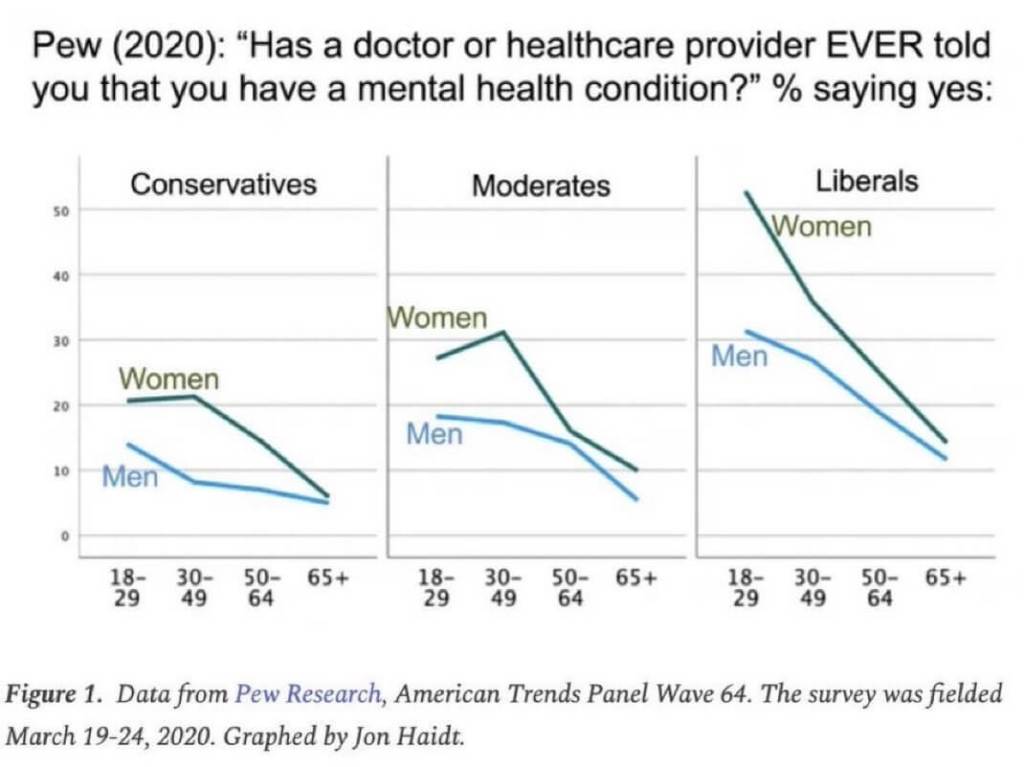
Perhaps G K Chesterton had a point when we stop believing in religion we ‘believe in anything’ Perhaps CSJ in general, and feminism in particular, is that anything.

 toxic feminism