Many media feminists, J K Rowling, for example, are dissatisfied with Labour Policy and, in particular, with Keir Starmer. Sir Keir has apparently ‘turned his back on women’ – ‘has marginalised women’ – ‘has erased women’.
According to the ever-unhinged Julie Birchill, writing in the Spectator, ‘the climate of misogyny now being as rabid as it has been since they stopped burning witches’ – really?
Labour’s policy offerings are overwhelmingly pro-female and indifferent to problems facing men and boys. These policies include prioritising the health of women – even though most health outcomes are worse in men. Making misogyny, but not misandry, a hate crime. Specific courts for rape trials even though are backlogs across the criminal justice system and prioritising violence against women and girls, even though men and boys are at greater risk of violence. If this is what being marginalised looks like most men would be happy to be ‘marginalised’ by Labour. Every sex specific policy of Labour favours women.
So what has attracted the ire of feminists such as J K Rowling, Sonia Sodha and Julie Birchill? The answer is Labour’s move to make gender recognition easier for some groups. We await details, but these plans differ greatly from the self ID proposed by Nicola Sturgeon (SNP) and Lorna Slater (Green Party) in Scotland. That policy was a manifest absurdity that would have allowed, for example, a rape suspect to change gender or be held in a women’s prison. As I understand it, Labour policies refer to those people, male and female, who have undergone gender reassignment surgery and have lived as the other sex for a prolonged period. This is a much more subtle and nuanced issue than is reflected in feminist scare stories.
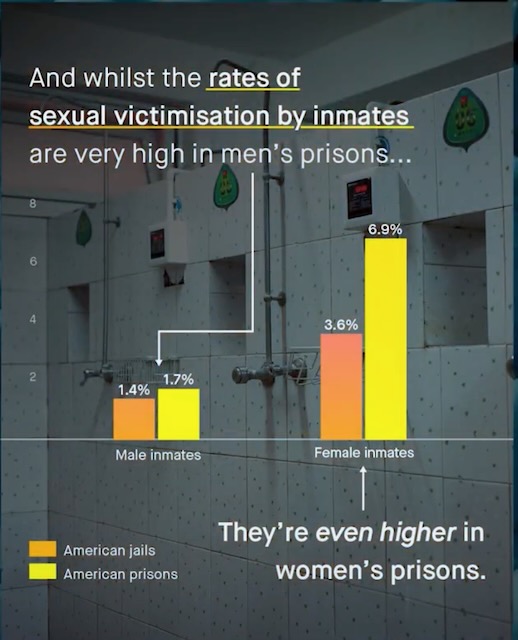
Would women in prisons and refuges be in greater danger from those who have undergone reassignment surgery and lived as the opposite sex or from their fellow inmates? Perhaps we do not know, but it is revealing that that question is not even asked. Blogger @thetinmen has, however, uncovered some interesting data that shows rates of rates of sexual victimisation are about 2 times higher in women’s jails compared to men’s. I suspect this reflects the much higher threshold to send women to prison rather than women being intrinsically more violent. However, it does mean that women may have less to fear from a trans woman than other female inmates. The same could be be true of women’s refuges. It was Erin Pizzey, the founder of the women’s refuge movement, who pointed out that many of the women in her shelters were themselves violent. When Phoenix Netts was murdered in a women’s refuge and her body left in a suitcase, Labour MP Jess Phillips lost all interest when it merged that she was killed by a fellow resident, even though the murder happened in her own constituency. For more on this case see here.
When this is pointed out, feminists claim this is not the point. The issue is, according to them, that their very identity is erased by the existence of transwomen. However, when you point out, that at the Tavistock clinic at least, there are three times more women transitioning to be men, therefore male identities are also being erased, the response is one of anger and denial.
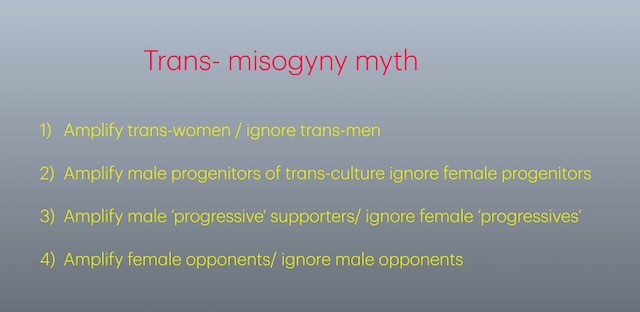
There are other ways feminists are revealing their deep seated misandry. Only male figures who have promoted trans-culture are foregrounded and attacked even though, as discussed in previous posts, the roots are feminist. Because of the omertà of feminism, no mention is made of female MPs who have supported ‘transwomen are women’. Stella Creasy, Nadia Whittome, Zara Sultana, Annelise Dodds have all supported trans rights. Inexplicably, Jess Phillips argued that although transwomen were not biological women, they should be treated as such (here). These women are remarkably quiet now, happy to let Keir Starmer take the heat.
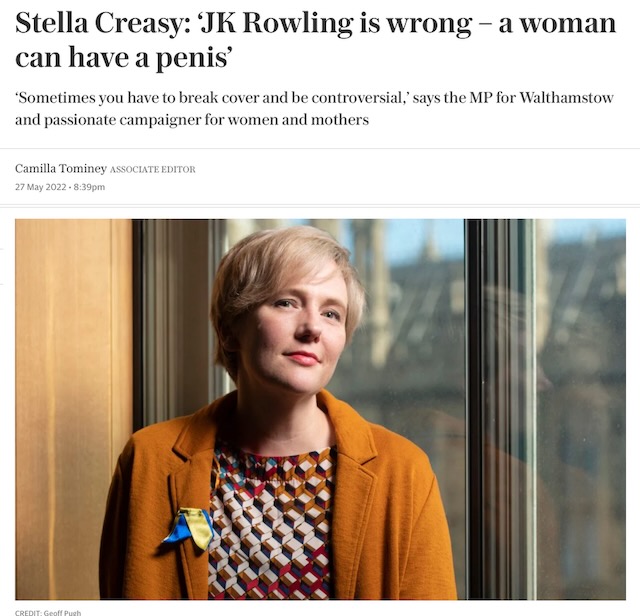
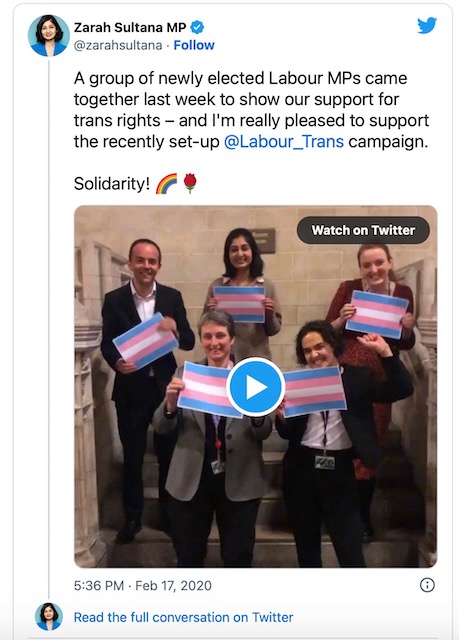
Neither was it just Labour women caught up in this. Penny Mordaunt of the Conservative Party argued that transwomen are women (here).
Similarly, looking at the Guardian, the daily paper of record for progressives, the ire of feminists has focussed on one person, Owen Jones. Meanwhile, female figures with similar views have largely escaped attack. Philosopher, Judith Butler gets column inches in that paper and has described resistance to trans culture as the last redoute of fascism. Self confessed genderqueer, Laurie Penney, has also written for that paper. If the focus of attacks on the Labour Party is to be its leader Keir Starmer, then surely the focus of attacks on the Guardian should be its editor Katherine Viner.
The other way feminists have revealed their misandry is by foregrounding female opponents of trans culture while erasing male opponents. There are men and women ranged on both sides of the debate but, because of the need of feminists to peddle transculture as a form of misogyny, you would not realise that. While Helen Joyce and Kathleen Joyce are rightly celebrated, men who have also been in the fray and who have sometimes lost their jobs are ignored. James Esses, Colin Wright, Graham Linehan, for example. Similarly, when Jordan Peterson attacked the compelled use of chosen pronouns he was attacked by feminist Cathy Newman who was in turn supported by her feminist peers at the Guardian. As always with feminism, double standards are operating.
So, it seems to me, that this is a more nuanced issue than it appears at first sight. It shows that feminists, far from lacking power, can easily capture the agenda. J K Rowling only had to click her fingers to get a meeting with Keir Starmer. The issue has also revealed a form of gamma bias. Only men transitioning to women are considered, only male supporters of ‘trans-culture’ are attacked. Meanwhile, male opponents are ignored. This is to give the impression of societal misogyny and create a wedge issue that can be used to attack men.

 toxic feminism