What should the Labour Party in the UK learn from the election of Donald Trump?
The election of Donald Trump has sent shockwaves around the world, particularly in left-leaning or liberal outlets.
The US is an independent nation that is free to elect whoever it chooses. However, unlike the UK, it makes a big difference to the rest of the world who the US public elects and for that reason, we all take a great deal of interest in US politics. That brings with it problems. Because the US election is widely reported in the UK media it is easy to think we know and understand more than we really do. I am sure there are nuances and subtleties of US politics that go over my head. In view of this, I write this with a degree of humility and I am happy to be corrected.
Putting aside the problems a Trump presidency might bring to citizens in the US. His election is a potential disaster for the rest of the world. If he ignites a trade war we could all be poorer. I find his apparently supportive relationship with Vladimir Putin deeply disturbing and a threat to the security of countries with Russian borders. My aim in writing this is not to signal support for Trump but to look at what left-leaning parties might learn from the failure of the Democrats.
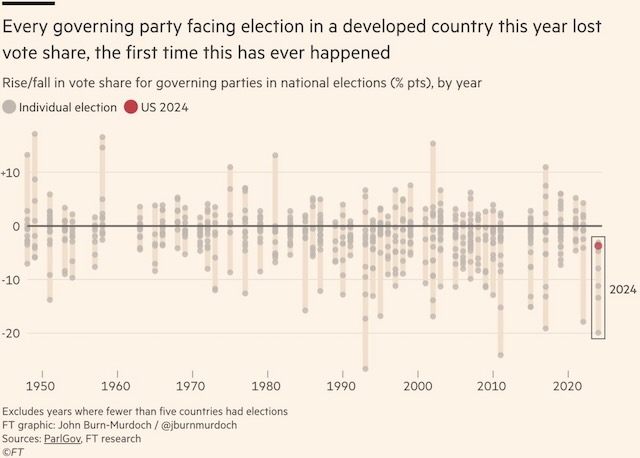
Although I am going to discuss issues affecting men, the biggest factors affecting the election were probably economic. At times of high inflation and economic turbulence, incumbent governments are more likely to be voted out even if they were not the cause of that inflation. We have seen that happen in the UK and it appears to be true across the rest of the world. Indeed, in this regard, the US is by no means an outlier – (see figure blow)
Don’t blame men
Much of the reaction in left-leaning parts of the UK press have been frankly unhinged. Take, for example, Arwa Mahdawi writing in the Guardian who argued that ‘Trump’s win has given angry incels enormous power’ She went on to say that ‘incels are in charge now.’ This was just lazy writing. Incels have become the ’boutique bogeymen’ of high status university educated women (here), who are invoked, with little evidence or research, to explain a wide range of social phenomena. Incels are small in number and being socially isolated, low in influence. Furthermore, research by William Costello shows that incels do not lean to the right and they are, on overage, centre left in their political affiliation (here). ‘Incel’ has become a lazy slur, equivalent to J D Vance calling Harris supporters ‘crazy cat women.’ We should call out both as polarising and unhelpful narratives. In fact, there is more evidence for the JD Vance slant on events if not his choice of words. Married women voted for Trump in greater numbers, whereas single women so called brides of the state (BOTS) leaned strongly democratic (see here).
Identity politics, including feminism, is electoral hemlock
I used to think that ‘woke’ was an electoral zero sum game. Dividing the world into victims and oppressors might gain you votes with supposedly historically marginalised groups (ignoring the inherent oversimplifications) but that would be offset by losing votes from those groups who are now to be demonised. Now I think it is worse than that. People respond more strongly to threats or negative messages than they do to positive messages and it seems more likely that this kind of divisive politics alienates more people than it inspires. Men may be alienated by overt feminist posturing to a greater extent than women, particularly older married women, are enthused by it. In keeping with this, other than single young female college graduates Kamala Harris did not increase her vote share. Successful parties need to look for universal narratives that unite rather than divide us along identitarian lines. ‘Make America Great Again’ might have been crass and simplistic, but it didn’t seek to divide us along lines of race or gender.
Labour should dissociate itself from the concept toxic masculinity
No matter how much it riles up some of its activists Labour should reject some of the teaching that is endemic in school RSE curricula. Contested concepts such as toxic masculinity or patriarchy should not be taught as fact. In this regard, Kemi Badenoch has a lead on Labour, though she hasn’t explicitly mentioned toxic masculinity she has challenged the teaching of contested ideologies as fact, within the RSE curricula of our schools. Those contested ideologies include patriarchy, toxic masculinity and that sex is assigned at birth. Labour has some catching up to do.
The revenge of the silent male voter
Claire Lehman writing in Quillette (here) has argued that the revenge of the silent male voter played a role in this election and I suspect she was right. Young men have grown up in an education system that views them as ‘toxic’ and face prejudice from DEI departments mostly staffed by privileged, college educated, young women. Not surprisingly they were looking around for support but saw a Democratic program that seemed to be more focused on the needs of women. Those men were enthused by the achievements of Elon Musk who to quote one supporter managed to catch a rocket with a pair of ‘f***ing chopsticks’. Although feminists sneered at endorsements from Elon Musk they gave an easy ride to an endorsement for the democrats from Taylor Swift whose main skill seems to be dancing and miming in her underwear for her adoring and mostly female fans. In short, Labour needs to be wary of the silent male voter.
Remember the Gillette advert
Remember that disastrous Gillette advert in the wake of #MeToo? The one where the average man was portrayed as some kind of predatory monster and the user of Gillette razors as a ‘goody two shoes’ feminist. It was a disaster and had to be pulled when sales of Gillette razors tanked. Indeed, sales have never quite recovered and the reputational damage to Gillette lingers to this day.

When the Democrats did target men it was to guilt trip them into voting Democrat. For example, cringey adverts asking males if they were man enough to vote for Kamala (here) were frankly insulting. Similarly insulting were portrayals of big ugly men trying coerce their partners into voting for Trump, the kind of portrayal that was picked up by Rebecca Solnit writing in the Guardian who, without evidence, claimed that a lot of households were dictatorships in which men controlled the voting intentions of their wives. This was, I believe, a hasty explanation for why married women were tending towards Trump in the run-up to the election.
The other appeal to men was to vote in the best interests of their partners: in particular, with regard to their reproductive rights. There was nothing wrong with that, of course; but imagine the outcry from feminists had Trump messaged to women that they owed it to their male partners to vote Republican. As a message to men, it was insufficient.
In one sense the Democrat’s misfiring campaign was encouraging. They recognised they had a problem with men and needed to reach out to them, but with no experience in doing so, they failed miserably. Hopefully, they will learn from this and target male voters more effectively in future elections.
Avoid the narrative shift
When a party fails to attract female voters it is a matter of concern and the question is asked what more should the party be doing to reassure and attract female voters? This is, of course, right and proper. However, when left-leaning parties are failing to attract male voters the question changes to what is wrong with men? And they are blamed for not voting the ‘right’ way. For obvious reasons, a party that wants to retain or achieve power needs to avoid this trap. Blaming men for the way they vote isn’t a good way to win an election. Instead, left-leaning parties need to ask themselves why they are failing to attract young men.
‘Traditional media’ may not be the best way to reach men
I don’t like the term ‘traditional media’ very much. In part, this is because the media is no longer traditional. 40 years ago about 50% of journalists were from the graduate class. Often they had risen through local newspapers and had spent time reporting on weddings funerals, industrial accidents, and so on; they knew a bit about the lives of ordinary people. Now, however, they are drawn almost entirely from the graduate glass and even then from a small number of elite institutions and within those institutions a narrow range of degree subjects – mostly humanities where critical theory has taken root. Not only that, but unpaid internships are an important way into journalism. The problem with this is that it selects those with family wealth to support them during their internships.
There are, however, podcasters with audiences much greater than mainstream channels. Trump knew this and went on Joe Rogan. Joe Rogan’s 10 most watched YouTube videos have achieved 410 million viewers, much more than most mainstream outlets achieve and that is why they hate him. Joe Rogan is criticised for having a mostly male audience but that is an opportunity for those wanting to attract young men. Kamala Harris should have accepted the invitation to appear on Joe Rogan. Had she done so, she might have been able to reverse some of her poor showing with men. Come the next UK election the Labour leader should be seeking similar outlets to reach men as well as women.
Specific male friendly policies.
In the run up to the last UK election every sex specific policy favoured women and girls. Close the (non existent) gender pay gap, rape specific courts, prioritise women’s health, more money for domestic violence charities. J K Rowling only had to click her fingers to get an audience with Kier Starmer. Post-election, the messaging has been no better. Closing women’s prisons so men would go to prison but women not, for the same offence. Bridget Philipson, Rachel Reeves and Chancellor Shabana Mahmood have all indulged in some very specific feminist messaging even though all three are arguably continuity candidates. We have had 3 female prime ministers so perhaps their appointments were not the triumph against adversity that they thought. The truth is that people care more, much more, about their competence than their gender.
All this would be fine if there were some specific male friendly policies. For example, acknowledge and take action to narrow the gender attainment gap, acknowledge that domestic violence isn’t a simple one-way street and funding should reflect this, male specific health policies and greater emphasis on suicide prevention which kills more men and women than homicide.
Conclusion
Trump didn’t really offer any male specific policies and many men may be worse off under his leadership. However, his messaging was less feminine and appeared less po-faced and censorious than that of the Democrats (viewed from this side of the Atlantic); that was enough to win votes among younger male voters.
Labour won at the last election because of an open goal left by two historically bad leaders in the shape of Boris Johnson and Liz Truss, as well as high rates of inflation that left most of us poorer. Bagpuss could have won the last election. Next time, Labour will have to do better. Improving its messaging to men would be a good place to start.

 toxic feminism
For once I disagree with you. Kamala could be the most crazed feminist on Earth but nothing justifies voting for the unhinged cesspit of corruption she was running against. God help us all, the yanks have re-elected a dangerous moron who openly admires Hitler. No woke provocation can make that explicable or acceptable. The human race is done, finished.
LikeLiked by 1 person
Thank you. Perhaps I didn’t do enough to distance myself from support of Donald Trump. I merely wanted to see what lessons the UK left could learn from his election rather than endorse his presidency in any way. Indeed, the only good (that doesn’t counterbalance the potential harms) I can see coming from his election is the democrats realising that in order to be elected they need to improve their offering to men.I will go back re-read my post and perhaps change the wording a little to take account of your helpful comment.
LikeLike
Test (login issues)
LikeLike
Okay, it seems to work again.
This was entirely predictable; I doubt very much that Trump and his party will help men in the slightest, but the left abandoned them a long time ago in its rush to pander to a few already privileged special interest groups.
The right only had to give the impression of listening a bit, and give a positive if rather vague vision for the future to pick up the young men the left was quite happy to abandon and marginalise.
What happens next is on Trump and his cronies, but the left has to share responsibility for getting him into power in the first place. They will of course avoid doing that at all costs, probably blaming men for the next four years; I’ve noticed that many commentators are asking why men voted for Trump, but as far as I can tell, most have carefully avoided actually asking the men concerned.
LikeLiked by 1 person
True. I fear the left will double down on its ideology and blame men or toxic masculinity for the election of Trump.
LikeLiked by 1 person