At last, some attention is being paid to pathways of female/feminist radicalisation. This matters and it is not merely ‘whataboutery.’ After all, it is no more rational to dismiss an argument as ‘aboutery’ than it is ‘whataboutery.’ Radicalisation isn’t just about online silos or echo chambers, though that can be a problem, it is also about the a reaction to the excesses, or perceived excesses of our opponents, otherwise known as hyper-partisan polarisation.
Activists know this and are aware that the reaction of your opponent is something that is useful. Indeed, it is part of Alinsky’s rules for activists. According to Saul Alinsky an important purpose of activism is to create a reaction that can be weaponised in support of a cause. We saw this, for example, in the demonstrations following the death of Sarah Everard. These demonstrations were peaceful and dignified until late in the evening when the activists arrived. They succeeded in provoking a reaction from the police in which some of them were dragged out, and those pictures are all anyone remembers about the otherwise peaceful demonstrations. One activist was heard saying ‘we have the money shot’ and then they left. They had succeeded in getting the reaction they wanted or in other words beautiful trouble is where the action is.
You can always rely on Claire Lehmann to think independently. However, unlike some other members of the so-called Intellectual Dark Web (IDW) she is not a counter-conformist who automatically opposes the current ideology. For example, she has not been afraid to take a ‘mainstream view’ on vaccinations and other public health measures and for that she has attracted the ire of more extreme adherents of the IDW. In the YouTube video below Claire talks about a subject that should be discussed more, the radicalisation of young women.
Claire starts by highlighting data that shows following decades where the political views of young men and women were approximately aligned, young women who have drifted to the hyper progressive left while men have roughly remained roughly around the centre. A huge gap that has only taken a few years to unfold.
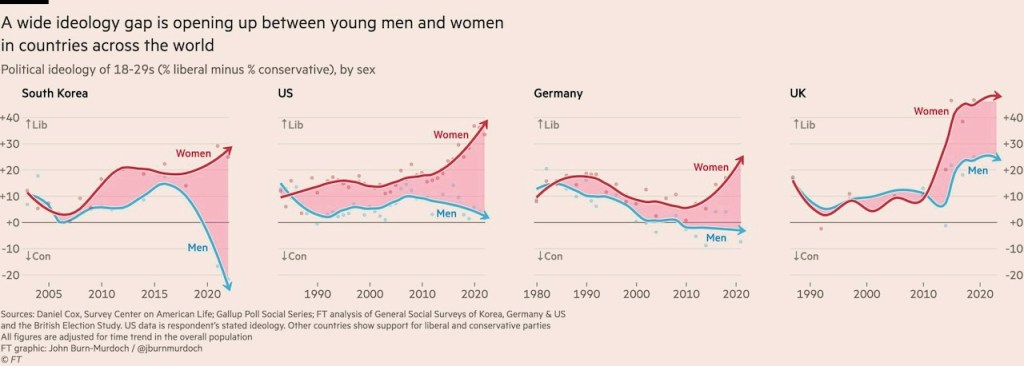
Claire points out that extremism and radicalisation are not terms usually associated with women but she observes that we do see destructive activism from young women. For example, cancel mobs tend to be mostly female and performative climate justice or pro-Palestinian activism are mostly female perpetrated.
One factor Claire points to is greater social media use by girls. For example, a recent survey reported by the BBC showed that girls were twice as likely as boys to be having problems limiting their social media usage and problems resulting from this included neglecting other activities such as sport and hobbies (see here). The kind of activities that are vital for healthy flourishing. The problem with media such as TikTok, Instagram and Tumblr is that they have been framing problems in terms of crisis, systemic-oppression and trauma. The algorithms reinforce polarisation by limiting exposure to other points of view. Anxious isolated girls spend more time scrolling generating more data for social media giants. As Claire Lehmann puts it, the algorithms don’t care if you are scrolling while depressed as long as you are scrolling.
Another factor is that female friendship groups may function differently to those of men. Men form larger and looser groups often based on some sort of competition such as gaming. Women, on the other hand, build smaller networks based on emotional support. Girls, it is argued, have a heightened fear of rejection by the group. In order to avoid rejection girls are more likely to endorse the shared beliefs of their group in order to maintain group cohesion. Sometimes those beliefs can be quite extreme and membership of the group may be tied to holding the correct political views. According to American psychologist David Geary, social contagions are about 2.5X more likely to spread among girls than boys (here). This is not just true for political issues, there have been epidemics of Tourette like symptoms or ADHD among girls spread by influencers. Claire argues that the rapid spread of social contagion in girls groups is partly explained by their social psychology.
The activism that is being spread on social media is shaped by a Manichean worldview called ‘critical theory’ that divides the world into victims and oppressors operating in accord to invisible systems of power such as patriarchy, white supremacy, or heteronormativity. In higher education, the subject areas that are dominated by this theory have mostly female students. One of the first subject areas to go down this intellectual rabbit hole was English Literature (here or here) and it is no accident that so many activist journalists come from this background (see blog post litcritfemsplainers). These humanities subjects are not just portals into journalism they have also spread critical theory into HR departments, and other administrative positions. These ideas, infused with critical theory, are divisive and harmful and result in lost productivity and resentment in the institutions that are captured by them.
Claire offers solutions as well as highlighting the causes of our predicament. She argues that we should develop narratives of dignity and agency rather than victimhood. Young women, she says, ‘are not the victims of systemic oppression, there has actually never been a better time to be a woman than now’. She argues that to defeat the polarisation young men and women we need to engage more in the real world rather than in online silos, contends Claire – I am sure she is right.
Another person engaging with the issue of female radicalisation is freelance writer, Ella Dorn. In her article in The Spectator ‘We need to talk about femcels‘ she points out that a growing number of women hate the opposite sex and she points out that if we are to talk about the ‘manosphere’ we should also be talking about the ‘womanosphere’ which appears to turn women off against men at a greater rate than the manosphere does the opposite. She points out that it is a looser coalition than the manosphere (I am not sure this is true) and its participants include radical feminist followers of Andrea Dworkin. Female university educated journalists and TV writers are likely to be part of the ‘womanosphere’ and they have been free and easy with anti male rhetoric. ‘Why I hate men’ was a headline in the Guardian and an article celebrating a tweet about ‘small dick energy’ as one of the greatest of all time appeared in the guardian. Try writing an equivalent piece about female genitalia and see how far you get. Or as recently as 2019 Andrea Dworkin could be celebrated as the ‘visionary feminist for our troubled times.’ These problems are not confined to the Guardian. In April 2025 a commentator on BBC radio 3 celebrated, without irony the life of Valerie Solanis author of the SCUM manifesto who shot Any Warhol.
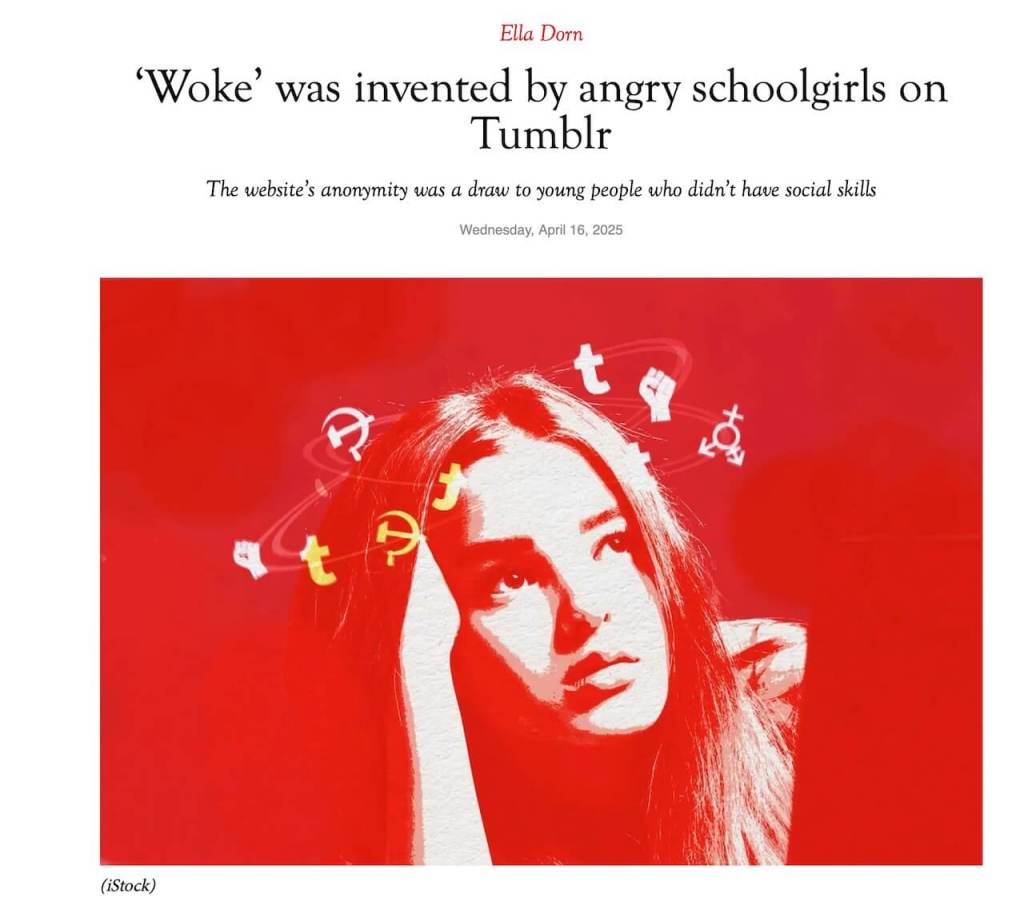
In another article in The Spectator, (Woke was invented by angry schoolgirls) Ella discusses the role Tumblr has played in radicalising young women. She argues that it has been a Petri dish for ‘resentful progressivism’ and the po-faced and censorious culture we find ourselves in first took root on this female dominated platform.
Bite sized retellings of the philosophy of Judith Butler or Kimberly Crenshaw went mainstream via Tumblr and many feminists arrived at university already radicalised. Ella goes on to argue that every institutional political correctness scandal has a Tumblr ancestor.
All this matters, there is a government consultation in progress but they are only looking at half of the equation- misogyny and the so-called manosphere. Female radicalisation is also a problem and perhaps an even bigger problem than male radicalisation because it doesn’t just affect a few lonely individuals who spend too much time online. Female radicalisation is problem among university educated journalists operating under an editorial framework.

 toxic feminism