(and other hypotheses)
It’s a brave man who ventures to discuss the greater male variability hypothesis (GMVH). Just ask James Damore or Larry Summers. The former was sacked from Google for daring to raise GMV as a possible explanation (among others) for the greater number of men involved in coding. Similarly, Harvard President Larry Summers was hounded out of office for observing that the standard deviation of math scores among men was greater than that among women (see post victims of feminist intolerance). He went on to suggest that finding might explain at least some of the difference in high achieving male and female mathematicians. Standard deviation is a measure of spread about the mean or average so you could have populations with the same means but the one with a greater standard deviation would have more individuals at the tails of the distribution. In this case extreme mathematical ability and extreme lack of ability.
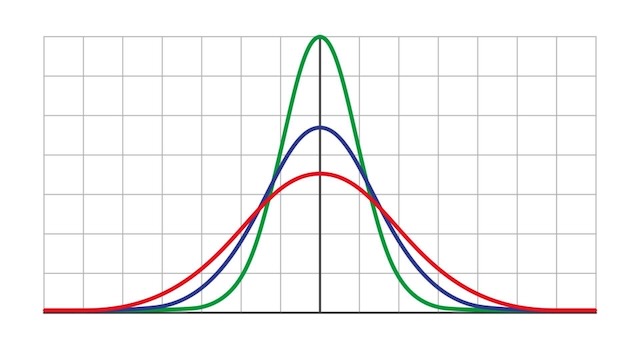
The figure above shows the spread of some trait, say mathematical ability along the x axis and frequency along the y axis. Three populations could have the same mean but different spreads (standard deviation). Supposing red represents males and green females. Although average ability is the same there would be more males at both extremes and this might go some way to explaining the greater number of male mathematics prodigies as well as duds.
In the case of mathematics, this isn’t entirely hypothetical, about 95% of the top-scoring participants in the 2023 Mathematics Olympiad were male and the same bias continues in the research sphere. Of the two dozen famous mathematical conjectures that have been cracked over the last 50 years, every one has been by a man. Feminists like to invoke invisible power structures to explain this imbalance; a glass ceiling holding women in place or a mysterious layer of power called the patriarchy. Perhaps that is why they become so hostile when the GMV hypothesis is even mentioned and that is why they organise themselves into cancel mobs.
It isn’t only in mathematics where this pattern emerges. Look at chess, another purely abstract pursuit that requires reasoning, spatial ability and obsessive focus. Again, men predominate, only 2% of grandmasters are female and this is despite concerted efforts to change that figure with women-only chess tournaments carrying substantial financial rewards and ensuring that female chess players are foregrounded in the media. Girls have no shortage of role models.
The GMV hypothesis is not new; Charles Darwin noted that males of most species tended to be more variable and now this is not even contentious. In humans, the greater variations in male birthweights, height or blood pressure are widely accepted. However, cognition is a more sensitive area. In some respects, this mirrors the attitude of activists towards evolution, which they accept in the animal kingdom but in humans, it apparently only applied below the neck and stopped in the Neolithic period.
The response to those who, with evidence, posit the GMV hypothesis is intriguing. When mathematician Ted Hill tried to publish a paper on this subject, rather than find flaws in his argument, it was described as ‘full gloves off misogyny’ – that familiar part of the feminist rhetorical fortress. Similarly, feminist Nel Noddings, without providing much in the way of contra arguments, described it as a ‘pernicious hypothesis’. And so it goes, anything that conflicts with a purely social constructionist view of the world has to be taken down.
The idea that population-level differences might account for some of the different representation of men and women attracts the ire of feminists, but only when women are under-represented. When women are ‘over represented’ in publishing, for example, that is something to be celebrated and represents ‘diversity’ and the superiority of women (here).
There are, of course, other possible explanations for male ‘over-representation’ at the highest levels of chess and mathematics. Looking at chess in particular Carol Hooven writing in Quillette has suggested that there are more men with the level of obsessive focus required to succeed in these fields. The sort of men who are prepared to forgo a normal social life in order to progress in their chosen sphere. Andrew Wiles who cracked Fermat’s conjecture looks like a good example of extreme focus as does, to an even greater degree, Grigori Perelman who was offered the Clay Millennium Prize for his solution of the Poincaré conjecture, but declined it. Perhaps there are more men than women with this extreme focus. Still no glass ceiling or invisible power structure in sight.
Other factors include greater male interest and enjoyment systematising activities such as math and coding whereas women and girls are more drawn to ‘people and things’. This difference is stable across cultures and is more strongly expressed in gender-equal societies. That means, however much that riles up feminists, that this difference between men and women is unlikely to be purely socially constructed. See here and here.
There are a range of possible explanations for male over-representation in activities such as mathematics and chess. Invisible power structures such as patriarchy are among the least plausible explanations.

 toxic feminism
It also explains what I’ve seen in social care: there seems to be a higher number of men struggling in society generally, which manifests in underachieving; violence, depression, self-deletion, alcoholism, homelessness et c. This is the flip of the larger numbers of high achievers.
Of course, feminists are happy to talk about this, and of course they say men ‘failing’ is because of innate characteristics of men, but still the higher number of male high achievers is because of Society / The Patriarchy. So it’s still “men’s fault” either way.
LikeLiked by 1 person
Great points. Perhaps I should have talked more at the men about the other end of the achievement spectrum.
LikeLike