Earlier this year the Women and Equalities Committee of the UK Parliament held a consultation on misogyny and the manosphere. Unfortunately, it was a rigged consultation with hand picked experts/activists. The committee has become ideologically captured and almost exclusively looks at issues affecting women and even then from only one perspective. This problem has got worse under the Labour Government which is itself ideologically captured by feminism. The enquiry included a public consultation to which I responded. Even here, I have my suspicions of deliberate rigging of outcomes. By the closing date a few of the responses, including mine, took sceptical approach to the subject. Then, the deadline was extended and everything after that deadline was took a feminist approach. To me, it looked rigged.
Below I have pasted in my contribution. As always, when you look back you wish you had worded some things differently.
“Misogyny the manosphere and online content
I live in the North of England and I submit my evidence as a private individual rather than as a member of any organisation. I have become concerned about the demonisation of men and more particularly boys, in the media and by politicians. I also feel uneasy that this call for evidence only considers one-half of the equation of hyperpartisan-polarisation.
Introduction. The climate in which evidence is being sought is one of moral panic triggered in part by the fictional account portrayed in the Netflix drama ‘Adoloscence’ which featured an improbable scenario of a young boy from a stable background, with two parents, stabbing a young girl. Though I am not a criminologist, I understand that the risk factors for violence have changed little and include socioeconomic deprivation, low educational attainment and absent father figures. The case portrayed in Adolescence featured none of those factors and, it seems to me, that it was on the same page as Victorian ‘penny-dreadfuls’ rather than great art or as it has been wrongly described both in Parliament and on BBC Breakfast TV, ‘a documentary.’ Furthermore, events around the release of ‘Adolescence’ felt orchestrated and many people, myself included, wondered if we were being manipulated or ‘softened up’ into accepting illiberal legislation.
If the problem of incels has been brought into the public domain by ‘Adolescence’ then that debate should be informed by empirical research rather than the opinions of the writers and producers of that program. We don’t accord that authority to the producers of other dramas. Writing for Casualty doesn’t make you an expert on health care and writing scripts for Dr Who doesn’t grant authority on matters of astrophysics.
Other writers have described incels as the ‘boutique bogeymen’ of high status middle class women who are the demographic who are least likely to be the victims of violent crime, but most likely to end up writing for our newspapers https://www.queermajority.com/essays-all/boutique-bogeymen
This is in part because they are useful to them, incels can be used to justify authoritarian legislation under the guise of benevolent concern for boys. Even the term incel has been widened by invoking something called ‘incel ideology’ or ‘incel culture’ which is a catch-all term that includes good faith objections to feminism (for a good example of this see https://www.newstatesman.com/comment/2023/10/incel-ideology-entered-mainstream ). According to Arwa Mahdawi of the Guardian, the election of Donald Trump was proof that incels were now in charge!
Another factor driving this distorted narrative may be taxpayer funded women’s advocacy organisations such as Women’s Aid affiliated charities or UN Women. Such organisations argue for continued or increased funding on the basis of a distorted and one sided account of the current state of affairs.
The moral panic that has been generated has increased traffic through incel websites and, I suspect, it has also helped Andrew Tate grow his toxic brand.
The term misogyny has become devalued. Misogyny has become another catch-all for a diversity of grievances. Even if those grievances are well founded, hatred or dislike of women may not be the underlying motivating principle.
Recent examples include the BBC describing medical training and even the NHS as misogynist based on a survey that only asked women their opinions. This could not possibly show that women were selectively more dissatisfied with the health care they received let alone whether misogyny was the underlying cause for that care. Similarly, Naga Munchetty argued that health care was misogynist based only on her personal experience with analgesia for a medical procedure. Putting aside why people who sit in front of a camera should be given more moral and epistemic authority than those who operate the cameras or sound recording equipment? There was no evidence that misogyny was the underlying cause for Naga’s perceived poor care or failings or the NHS in general.
Even ‘trans culture’ has been described as medical misogyny even though, according to YouGov data, women were more likely than men to support a range of transgender rights. This suggests to me that, whatever the rights and wrongs in the debate, misogyny is unlikely to be the guiding principle for most advocates on either side.
The belief that any disagreement with feminism constitutes misogyny runs deep. According to Andrea Dworkin, for example, ‘feminism is hated because women are hated. Anti-feminism is a direct expression of misogyny; it is the political defence of women hating.’ In short, there is no such thing as a good-faith objection to any aspect of feminism – only misogyny. Andrea Dworkin is no fringe figure and was described in the Guardian as recently as 2019 is the ‘visionary feminist for our troubled times.’ Too often, good faith debate around feminism is terminated with the accusation of misogyny and the allegation can be used to avoid engaging with conflicting opinions. Hate speech or other illiberal laws would further reinforce this rhetorical tactic and suppress debate.
These are not isolated examples, the list of things described as misogynist in mainstream media keeps growing and has included,
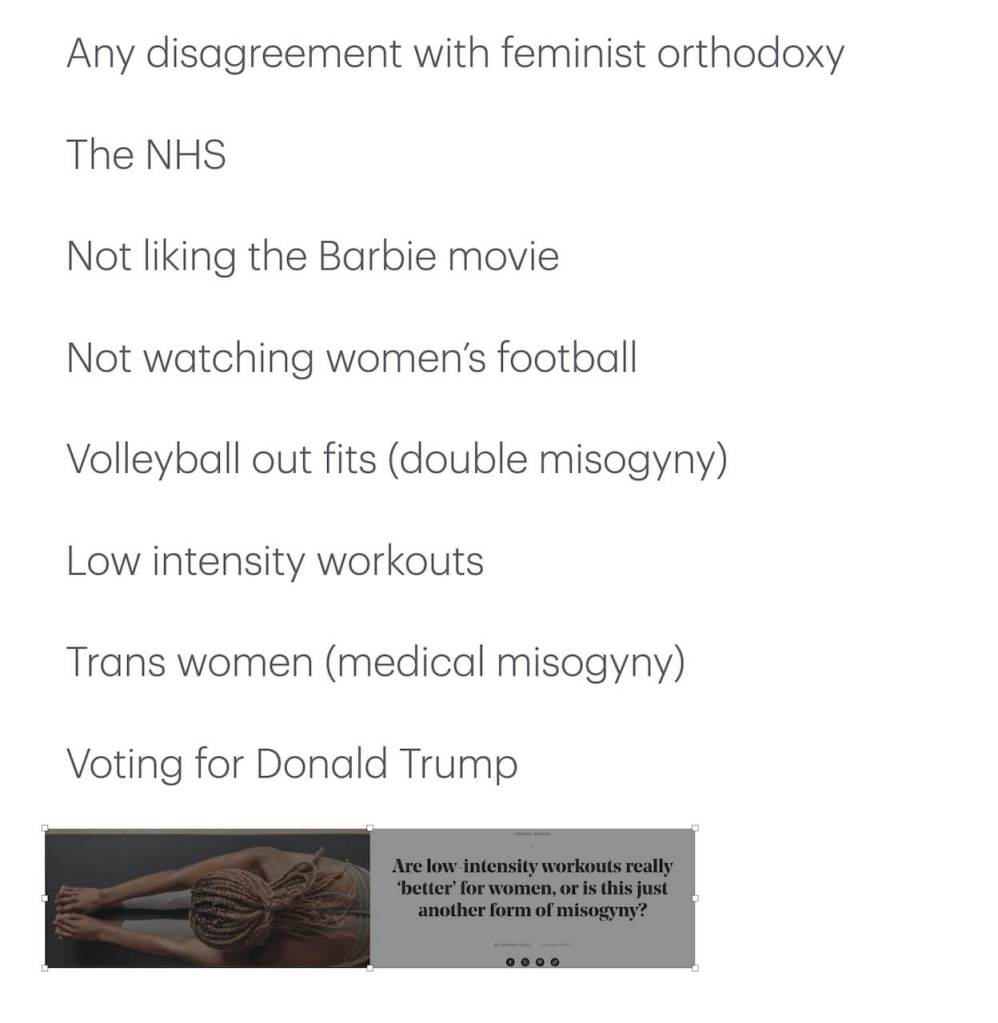
Social scientist Musa Al Gharbi has helped us by plotting the prevalence of prejudice-denoting words in the media. That study showed a dramatic increase in the frequency of the word misogyny in mainstream media particularly between 2010 and 2019(1) . It may be that there is an epidemic in the misuse of the word misogyny rather than, as some have claimed, an epidemic of misogyny itself.
Is the prevailing climate one of societal misogyny? There is a body of evidence that says not, both male and female subjects are more favourably disposed towards women but this bias is more strongly expressed in women. For example, implicit bias studies have shown that it tends to be men rather than women who are at the wrong end of negative implicit beliefs(2) (3). The latter study by Halim revealed that girls showed more gender bias than boys but that improved with more time in each other’s company. In short, it was girls who, on average, were being socialised out of negative gender stereotypes.
While I am sure misogyny is sometimes a motivation, the claim that violence against women and girls is predominantly motivated by misogyny is open to question. The approximately 1% of men who are habitually violent are 3-4 times more likely to be violent towards other men.
Even the Global Gender Gap Index published by the World Economic Forum (WEF) institutionalised these biases; it has been constructed in such a way that it can not reveal male disadvantage where it occurs. If men are behind it is recorded as equality and if women are behind it is recorded as inequality(4).
A more detailed review of this topic is outside the scope of this document but psychologist Corey Clarke has reviewed a wide range of studies that point in the opposite direction of societal misogyny; by and large societal biases favour women(5) (6).
Misandry has become mainstream and normalised ‘Why I hate Men’ was a headline in the Guardian and a book of the same name was widely available in bookshops and was favourably reviewed in national newspapers.
A tweet featuring ‘small dick energy’ was described as one of the greatest of all time by Rebecca Solnitt writing for the Guardian. In all these cases, it requires little effort to imagine the outrage if the genders had been reversed on those headlines and it tells us that the ‘Overton window’ of what is allowable discourse is pushed towards the misandrist end of the spectrum.
These problems extend beyond the Guardian. BBC radio 3 in introducing some music celebrating the life of Valerie Solanas, was somewhat kind to a figure who wrote the SCUM manifesto and was imprisoned for the attempted murder of Andy Warhol and a fellow art critic. Solanas, in terms of extremism, would be ‘on the same page’ as Andrew Tate. However, the former was celebrated without irony on BBC Radio 3.
Following the infamous Jordan Peterson Cathy Newman interview attention was rightly given to abusive tweets directed towards Cathy Newman. However, less attention was given to the greater number (by some estimates) of abusive tweets directed at Jordan Peterson. One important difference, however, was that much of the abuse towards the latter came from mainstream sources and the tweets were retweeted multiple times. One journalist tweeted ‘standing ovation for Cathy Newman who is interviewing oceangoing dickhead Jordan Peterson and hasn’t yet punched him’. When challenged, she doubled down and said ‘she would have punched him.’ Notwithstanding this sort of rhetoric, that journalist could subsequently be invited to appear on BBC Radio 4’s ‘Sweet Reason’ lecturing the rest of us on standards in online discourse https://www.bbc.co.uk/sounds/play/b0bbslsr . While I don’t think she should have been excluded, some exploration of the nature of her tweets might have been illuminating. (I am happy to provide the name of the journalist and the details of the tweets).
On social media, attempts to engage with feminism are frequently met with abuse. I have found that the accusation of incel, misogynist or if objective data is supplied, that ‘data is the new male wank word,’ are frequent occurrences. Perhaps most offensive of all is the accusation that to challenge feminist orthodoxy is to condone rape-culture.
Although this might all be dismissed as ‘whataboutery,’ it is no more logical to dismiss a response as ‘whataboutery’ as it is to dismiss the original argument as ‘aboutery.’ Hyperpartisan polarisation is a real thing and we all react to the excesses or perceived excesses of our opponents(7). Calling out double standards requires comparison, this isn’t ‘whataboutery,’ it is how bias is revealed.
I am not alone in highlighting this issue, Claire Lehmann in a Quillette podcast has drawn attention to forms of female radicalisation https://quillette.com/2025/05/01/the-radicalisation-of-young-women/ . Similarly, in the Spectator, Ella Dorn discussed the issue of ‘femcels’ and radicalisation of schoolgirls on Tumblr(8) (9) .
Any attempt to diffuse extremism among men and boys has to be matched by similar attention to the extremism among women and girls that can be found and is indeed celebrated in mainstream channels as well as social media.
Risks of censorship Illiberal legislation, if enacted in response to this consultation, will become part of a rhetorical fortress that seeks to make feminism an unassailable ideology. The belief that there is no such thing as a good-faith objection to feminism and that it is all misogyny, runs deep.
Neither is the risk of censorship of non-feminist points of view a distant or abstract fear, it is with us here and now. For example, I have had reviews of Laura Bates’ book ‘Men Who Hate Women’ blocked even though they contained no invective and conformed to community guidelines. Indeed, more vituperative reviews were left in place because, I suspect, they were useful to activists and could be seen as proof that misogyny is mainstream. I am happy to provide copies of these reviews. Neither am I alone in this, blogger William Collins, author of ’The illustrated empathy gap’ wrote a thoughtful review of the above book, pointing out factual errors, that was removed from the Amazon website.
Other bloggers have encountered a similar problem, fighting4fair for example has catalogued a large number of cases where non-feminist points of view have been erased by moderators. Hate speech laws would inevitably make this problem worse as social media platforms adopt the precautionary principle of ‘if in doubt cut it out.’ Furthermore, the tactic of ‘guilt by association’ means that all objections to feminism will be labelled as far right, incel or tainted by Andrew Tate.
Looking around the world, there are many examples of men losing their jobs for challenging feminist beliefs. James Damore lost his job at Google for expressing an opinion in an internal memo that was rooted in evolutionary biology. Alessandro Strumia lost his job at CERN for arguing (perhaps wrongly) with data that women were being promoted with a smaller number of publications, Larry Summers was hounded out of his post at Harvard for proposing the greater male variability hypothesis as a reason for ‘over representation’ of men in higher levels of mathematics. In the UK, William Knowland, an English teacher at Eton, lost his job for producing a video called The Patriarchy Paradox which challenged the notion of patriarchy. While I don’t necessarily agree with all that these people have said, I do not believe they were motivated by misogyny and neither do I believe they should have lost their jobs.
It is not only men challenging feminist orthodoxy who risk censure. Psychologist Corey Clark who I cited above was told by a female delegate at an academic meeting that ‘she wanted to push her down a lift shaft’. Currently, in Australia, sociologist Fiona Girkin is facing calls for her to be sacked because she called for the police to look for actual evidence of who is the perpetrator in cases of domestic violence. Challenges to the ‘believe women’; narrative are classed as misogyny.
Disagreement should be negotiated without accusations of misogyny and unverified claims of victimhood. However, feminism is becoming an authoritarian movement and illiberal legislation such as misogyny-hate-speech laws could make this problem worse.
The manosphere The manosphere has become a lazy and reductive term. It is no more rational to reduce all men’s activism to the ‘manosphere,’ characterised by incels and Andrew Tate, than it is to reduce all women’s activism to the ‘femosphere’ characterised by Julie Bindel, Valerie Solanas or Andrea Dworkin. Yet that is the standard of debate in many public forums where feminism is treated as a sacred ideology and any opposition a form of blasphemy. To be fair, the term manosphere was coined by some men’s rights activists but it has since been weaponised and distorted beyond recognition and adds nothing useful to the debate. Guilt by association is an important tool and to challenge feminism is to be lumped together with figures such as Andrew Tate.
There are many thoughtful men’s activists (as there are women’s activists) including blogger William Collins, @thetinmen on Twitter or Richard Reeves. These voices need to be heard more, not lumped into a meaningless catch-all category – ‘manosphere.’ When men’s voices on gender issues are heard it is usually on a forum curated by feminists. That needs to change, both for the good of feminism and men’s advocacy. However, illiberal hate crime laws could make people even more reluctant to foreground those views that need to be heard.”


“In the 1980s, Ghislaine Maxwell founded the “Kit Kat Club” in London, a social and professional gathering place designed to bring together influential women from the worlds of arts, politics, and society. Maxwell was a prominent London socialite before later relocating to the United States.”
Is it misogynistic or does it sound feminist ? I think there is only one word that makes the difference.
LikeLike