men were some of the least radical demographic groups of the whole country. “
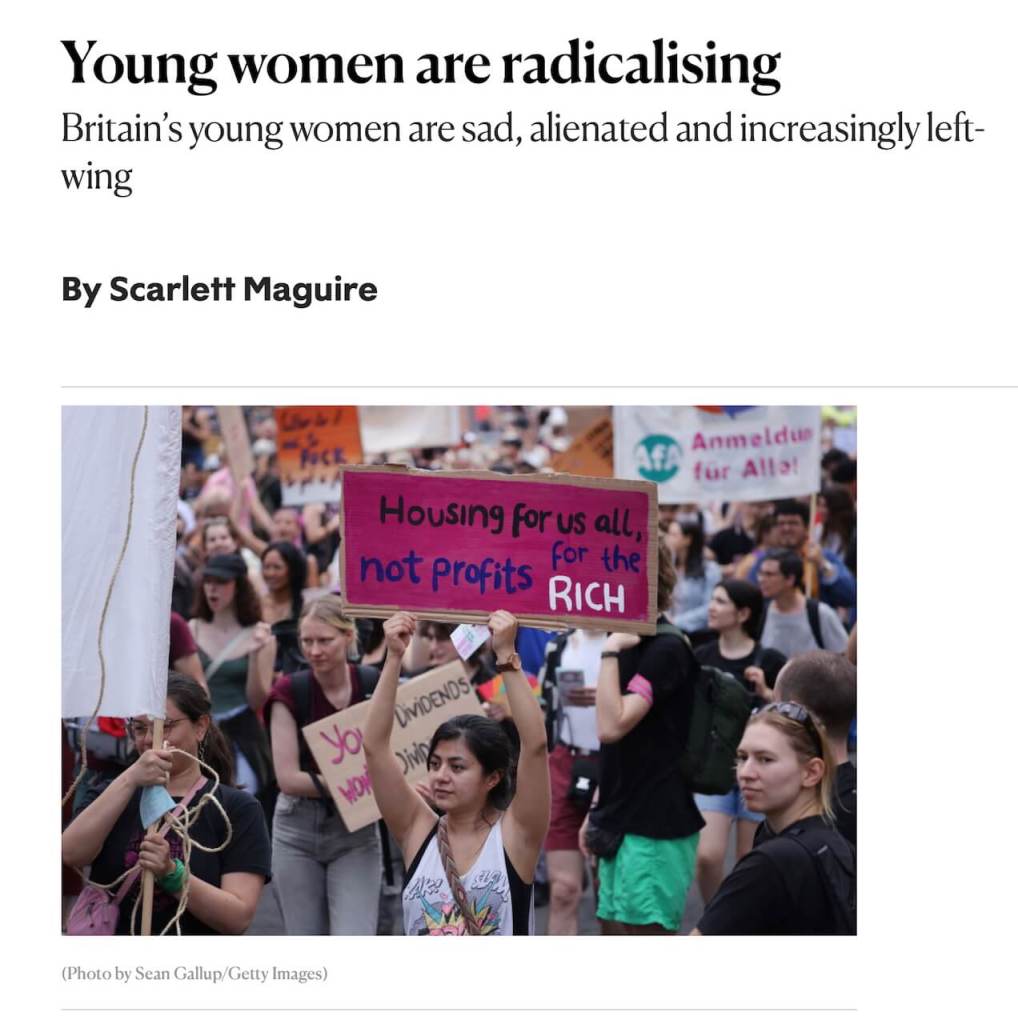
An interesting article from New Statesman (here) runs counter to the standard populist narrative that young men are porn addled misogynist extremists. It seems that there may be more problems with young women moving to the identitarian and progressive left, and making themselves unhappy and lonely in the process. Contrary to Government propaganda, it isn’t boys who need to be ‘re-engineered’.
It is tempting to view this with glee, but we shouldn’t. My attack is on the way these issues have been covered by some journalists and charities with an agenda, rather than on women themselves.
The issue has been covered elsewhere in this blog (Framing of the Gen Z Political Gap). In the media, the growing political gap between young men and women has been framed as young men drifting to the right. However, other than South Korea, this isn’t supported by the data, which shows young women drifting off to the progressive left while young men stay around the centre.
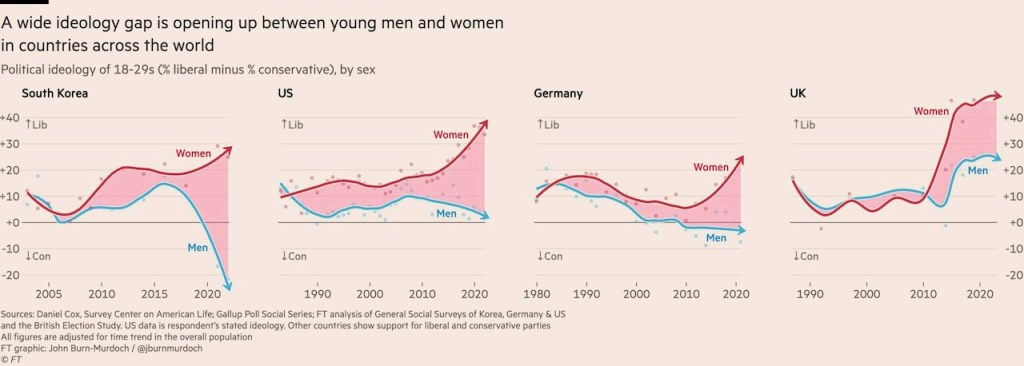
Although young men were more likely than young women to support Nigel Farage, they were much less likely to support him than the general population. Young women, on the other hand, are much more likely to vote Green. 23% of young women voted for the Green Party compared to 6.7% of the general population. At first sight, this might seem like a good thing. Many of us, myself included, care passionately about climate change and environmental degradation. However, I am not sure the Greens are that interested in what should be their core issues. Instead, they have backed the wrong horse in the trans debate, they have called for disagreeing with a woman to be classed as misogyny and pushed for some wildly left-wing fiscal policies. This is a disaster, making progress on ‘green issues’ requires building coalitions across left and right, and across age and sex, rather than promoting identitarian wedge issues. As a result, in some quarters at least, climate change activism is seen as a subset of woke ideology. The Greens are as much to blame for this as reactionary figures on the right.
Indeed, much of the environmental posturing of the Greens looks performative to me. While an unfashionable group -anglers (mostly male), were out and about on our rivers, cataloguing the damage and campaigning against environmental destruction wrought by water companies, the Greens were calling for self ID for transmen and transwomen. (See Climate Change is not a Culture War Issue). Indeed, some of my young Green supporting relatives don’t seem to live their lives in a ‘Green way’ at all, buying too many clothes, washing them too often, taking 40 minute showers and anointing themselves with environmentally damaging products.
None of this is recent; 18-25 year-old women were the only group to break for Jeremy Corbyn in the disastrous (for Labour) 2019 election. Or in the US, Kamala Harris only managed to increase her vote share among single college-educated women and there weren’t enough of those to win her the election. There is a clear message for UK Labour here; chasing the female 18-25 vote will likely alienate the rest of the population – not just young men but older married women too.
The article also revealed that young women are substantially more pessimistic than young men, even though their employment and earning prospects were better than those of men (among young people, the gender pay gap has reversed). Furthermore, although there has been talk of a loneliness epidemic among men (for which evidence was always thin), according to the article in New Statesman, far more young women reported feeling lonely, ~53%.
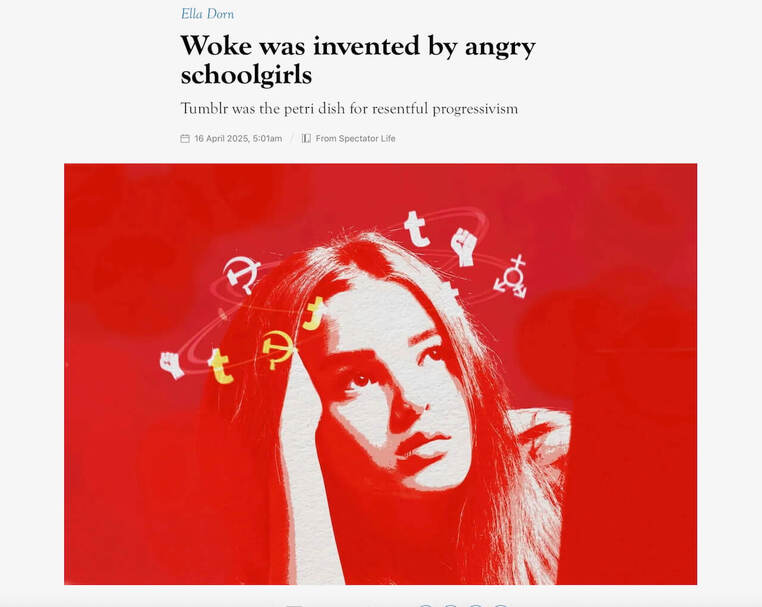
Social media may be a factor; young women use TikTok and Tumblr substantially more than men and that can be a powerful vector for social contagion. That online social media consumption was most stark for young women with university degrees. Other commentators have discussed the radicalisation of young women and the possible role played by Social Media. For example, Claire Lehman writing in Quillette (here) or Ella Dorn writing in the Spectator (here). Despite this, the focus is mainly on the social media consumption of young men.
Another factor may be the subjects that young women are more likely to study at University. In social sciences and humanities, the dominant paradigm is Critical Social Justice (CSJ) and that is a recipe for radicalisation and unhappiness. If you believe that there is an invisible layer of power called patriarchy that will hold you in place and stop you from thriving, you might feel unhappy and alienated.
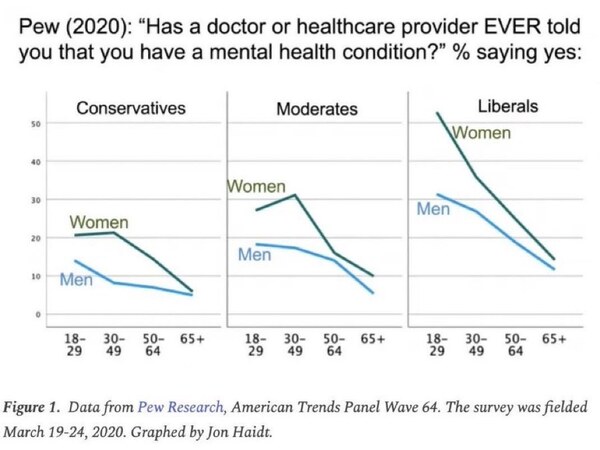
Does the radicalisation of young women matter? For several reasons, I believe the answer is yes. First, because it seems to be a recipe for personal unhappiness. Contrary to media portrayals, stoicism seems to be conducive to good mental health. The least happy group, at least judged by self-report, seems to be young liberal women. This may be because, as others have observed, CSJ operates in the opposite way to cognitive behavioural therapy. Where the latter encourages putting a favourable interpretation of the words of others and to avoid catastrophising, CSJ encourages its proponents to look for the worst motives – all disagreements with feminism are misogyny, for example.
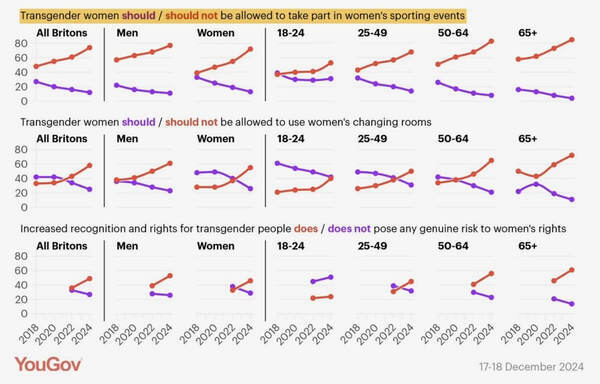
We should remember that the primary supporters of trans-ideology, not withstanding the risks posed by men in women’s sport, have been young women. Again, the radicalisation of young women has had serious real world consequences that affect men and women. The attempt of feminists to blame this on men, because the most obvious conflict with reality was men in women’s sport and women’s prisons, conflicts with empirical data on the supporters of gender ideology – radicalised young women.
Another reason why the radicalisation matters is the corrupting effect on female-dominated institutions. Helen Andrews, writing in Compact, has noted that the institutions in academia that went most ‘woke’ were those that had recently become majority female. With that came a greater willingness to cancel speakers with whom they disagreed and a desire to restrict what subjects could be researched. In short, the well-being of supposedly marginalised identity groups was prioritised over the search for truth. Extended to the legal system, where women now dominate, the results could be a matter of great concern. Radicalised young women, who have immense social power, may be a bigger threat than we realise and a bigger threat than the supposedly radicalised boys.
Postscript
Since writing this piece, other journalists have come to similar conclusions. For example, Douglas Murray writing in the Spectator, has written about ‘The young women hypnotised by Polanski.’ In the Daily Telegraph. Zoe Strimpel has written an article ‘We need to talk about what is going wrong with young women‘ she notes that you women are more likely to be attracted to the performative ‘greenism’ and to believe Gaza is the single most important issue facing the UK.
More recently, Toby Young writing in The Spectator has drawn attention to the rise in what he calls ‘toxic femininity’ (here). Though it feels emotionally rewarding to retaliate with talk about toxic femininity, I think we should avoid the sorts of polarising narratives adopted by feminists. Nonetheless, it is a good article.
Both of these commentators come from the right; there is nothing wrong with that, but my politics are of the centre left. The lesson is that in the UK, the Labour Party needs to be aware of this problem and chasing the 18-25 female vote could lead it to electoral oblivion. Also, we need to understand more about the radicalisation pathways affecting young women as well as those affecting men. I don’t imagine the Women and Equalities Committee will be looking into this any time soon.

 toxic feminism
I share your concerns and as we’re about the same place politically, I feel the same discomfort as well.
I think a lot of organisations with questionable ethical pedigrees, have realised fminism and wke issues are a great smoke screen: putting up rainbow flags and making emotionally charged (and largely meaningless) commitments gets the young w*men you describe on their side, maybe buying their products, but certainly not looking too carefully at how well the organisations treat workers, tenants, and the environment, and leaving these companies are free to push for legislation that is detrimental to many.
I think this is related to the second point you made: for many “activists” their concern and anger is performative, and they seem to see no connection between the feel-good activism they engage in and their own lifestyles.
In this context I can’t help feel that those pushing this agenda, and especially the politicians in the Greens/Labour party are effectively acting as enablers for anyone with a vested interest in reducing workers rights, or maintaining the status quo instead of say, switching to a greener energy.
Not only doe they give these groups an opportunity to use more extreme “progressive” ideologies to discredit things like the science behind climate change, they also allow them to make token “progressive gestures”, secure in the knowledge this will shield them from any real scrutiny, because the very parties and journalists that should be holding them accountable are too busy pandering to the activists.
LikeLike
Thanks for your thoughtful reply. Like you, I don’t think most progressives really care about the downtrodden nor the Greens environmental issues.
Musa Al-Gharbi writes very well about this in his book ‘We have never been woke’
Once again, thanks for your comment.
LikeLike
It’s a good news: now they can finally join the army, defending this society that’s made for them.
I am gonna stay at home, washing the dishes. You know that’s a lot of anxiety for me…
LikeLike
Not sure how you make those extrapolations from my post. Nonetheless, thank you for reading my blog and thanks for your response.
LikeLike
I expect radical people to be more motivated to fight for their rights.
I guess I am influenced by the latest international news…
LikeLike
Thanks, I don’t think ‘progressives’ have a monopoly of wisdom when it comes to human rights. Authoritarianism can spring up on the right and the left of the political spectrum.
LikeLike
Thanks, at least we can agree on something – horror at some of the events unfolding in the world. My feeling, however, is that the excesses of some ‘progressives’ have been a gift to the far right. Hyperpartisan polarisation can be a real problem.
LikeLike
In the UK, I don’t know…
If I check your own site, everyone seems to be pretty much to the left in the UK.
In France, that’s true. Now they attribute rapes to migrants. I associate personally this concern about rape to genetic purity and to prevent “cuckoo breeding”, so it should be more a right wing thing.
I think the feminists are just being opportunistic here, exploiting something that is biologically written in us. That’s the point of my first comment: if we want true equality we should ignore what pushes us to spare women…
Less pressure, less demanding with them, less output…
Of course that’s a general comment and doesn’t describe the reality of every women…
LikeLiked by 1 person