You’ve got to be taught
To hate and fear
You’ve got to be taught
From year to year
It’s got to be drummed
In your dear little ear
You’ve got to be carefully taught”Rogers and Hammerstein , South Pacific
So goes the first verse of ‘You’ve Got to be Carefully Taught,’ a beautiful song from South Pacific. And that brings me to a recent article from New Statesman that has been ‘blowing up’ the internet. It really shouldn’t have done, however. Right-leaning figures have been warning us about the problem of female radicalisation for some time. Claire Lehmann has highlighted the radicalisation of young women and how it may be a bigger problem than we think (here). Similarly, Ella Dorn writing, for the Spectator, argued that ‘woke’ was invented by angry schoolgirls on Tumblr (here. I haven’t read her work, but Freya India reportedly shares these concerns..
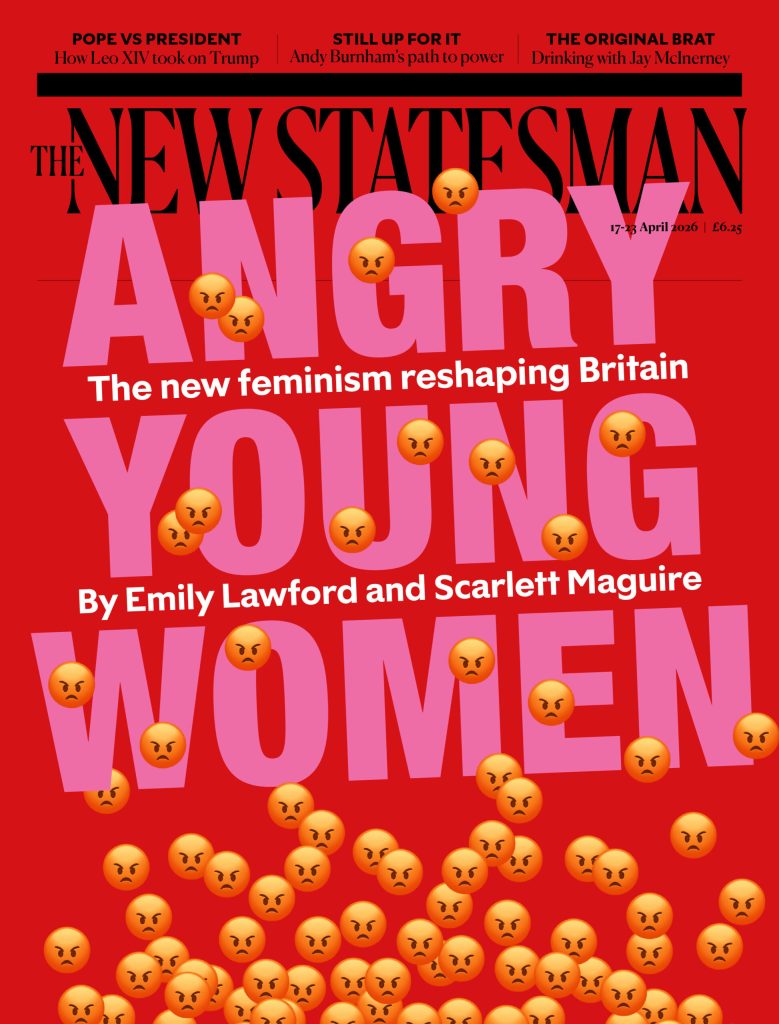
A New Statesman article reported a Merlin Strategy poll of 2,000 Gen Z adults, revealing that young women are becoming more radical while young men remain centrist, despite debates about the manosphere. Young women, though outperforming men in education and pay, were more pessimistic about their future—especially those from affluent backgrounds. White young women were also more likely than ethnic minorities to view the UK as irredeemably racist and cite Gaza as a major issue. Notably, the poll found concerning attitudes between genders, contradicting prevailing narratives.
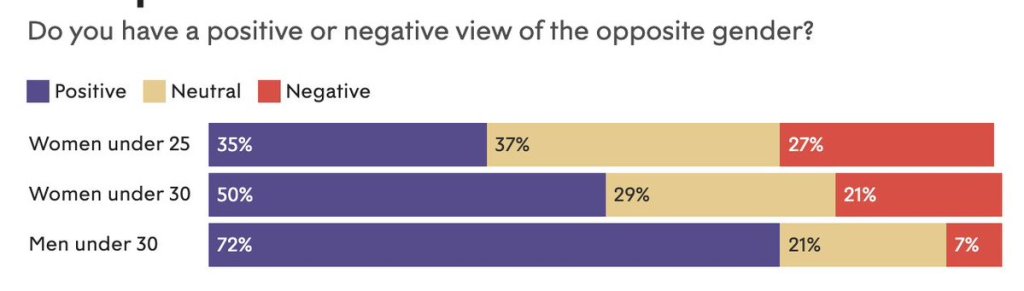
What the article revealed was that men overwhelmingly had a positive view of the opposite sex but the same was not true of young women. Only 35% of women under 25 had a positive view of men and only 50% of women under 30 did. Perhaps this has always been the case and this is just another moral panic, but I suspect that, in the words of the song from South Pacific, ‘you’ve got to be taught to hate and fear’ somebody has been doing some ‘teaching.’ Below, I discuss what form that teaching may have taken.
- Belief in patriarchy – if you believe in this conspiracy theory, that there is an invisible layer of power organised by men, that means you will struggle to achieve your potential, you might well come to hate men. Unfortunately, ‘patriarchy’ is just a lazy catch-all theory to explain away differences between men and women. The patriarchy is as real as the tooth fairy.
- If you believe the men stole credit for women’s achievements, you might, once again, come to hate men. There is a whole publishing genre about promoting these myths. A good example would be revisionist histories such as Cathy Newman’s ‘Bloody Brilliant Women,’ but there are shelves full of them written by women from similar upper-middle-class backgrounds. Rosalind Franklin did not discover the double helical structure of DNA before Watson and Crick and they did not steal her notebooks. Ada Lovelace did not write the first executable computer program. Despite this, these myths, and many others, are shamelessly pushed by second rate hacks in the publishing industry. In truth, if you look around any celebrated achievement, you will find a halo of people whose contributions are perhaps underappreciated. Whether women are overrepresented in that halo is doubtful.
- Hyping up incels and the manosphere. You might think that incels are the biggest threat to the safety of women, even though they are few in number and a bigger threat to themselves. The reality is that in the UK, there isn’t a single killing unequivocally linked to incels. The Southport killer, for example, had Al Qaeda material on his computer, but instead the media focused on possible incel associations. Chris Ferguson, who always writes well on moral panics, summed it up nicely when he described incels as the boutique bogeymen of high-status women (here). Matters weren’t helped by the drama Adolescence, which was taxpayer funded and described by Keir Starmer speaking in the House of Commons, as a ‘documentary’. It wasn’t, there is not a single case of a boy from a stable home background with two parents being drawn into incel culture and stabbing someone. The drama was on the same page as Victorian penny-dreadfuls rather than great art.
- Hyping up violence against women and girls. While we shouldn’t be complacent, violence of all kinds has been in decline since the 1990s. That is something to be celebrated and analysed so we know what changes have led to that reduction. It remains the case that the small percentage of men (and smaller but not non-existent percentage of women) who are habitually violent are 3-4 times more likely to be violent to men. That suggests that misogyny is not the prevailing motivation. Indeed, it suggests that even among violent men there is a taboo against violence towards the opposite sex. Nonetheless, violence towards women and girls is discussed in isolation and always preceded by terms such as ‘epidemic’ or ‘National Emergency’.
- Ignoring real risk factors. The risk factors for violence are unchanged and include socioeconomic deprivation, adverse childhood experiences, an absent father figure, low educational attainment, amongst others. These risk factors attract little interest from upper-middle-class-feminists.
- Mis-telling the fight for abortion rights. Once again, this wasn’t men and women in opposition to each other. The most in favour were liberal women and the most opposed were conservative women. Men, as usual, were less polarised and on average less opposed to abortion rights. Contrary to feminist propaganda, the fight for abortion rights was not between men and women. See –the gender war that wasn’t–
- Mis-telling the story of universal suffrage. The struggle to achieve universal suffrage was not between men and women. It was primarily waged between the haves and have-nots and most of the heavy lifting was done by men. The 1918 act granted the vote not only to women but also to 6.5 million men and the catalyst for that act was not the suffragettes, who were opposed to the enfranchisement of working-class men and women, but WW1 and also events in 1917 Russia.
- That men are six times more likely than women to desert their sick partner. This vile piece of propaganda arose from a paper that was subsequently retracted because of methodological flaws (here), but not before it had spread its poison. Even though it has been retracted, that statistic continues to spread. The best available evidence from systematic reviews is that there is no increase in divorce rate following cancer diagnosis in either partner (here) and (here).
I don’t blame the young women who participated in the Merlin survey for having a negative view of men and masculinity. Given the propaganda they have been fed, we shouldn’t be surprised. Our ire should be directed at the teachers, sometimes in the literal sense, but more often at the purveyors of misandrist propaganda in other domains. The journalists who write slanted and biased copy, the populist authors such as Laura Bates stoking moral panics to sell books and the gullible hacks who fail to scrutinise her claims. The writers of revisionist histories and the politicians using fear as a divisive weapon. And finally, the ‘academics’ who have given up on empirical method and instead produce activist propaganda. They are all deserving of our contempt in equal measure.
*Since writing this I have become aware to two substack posts that cover the same territory – only better. The first by GENX Anecdotes The manosphere isn’t the problem. Feminism is. The second by Saving Culture (from itself) is also well worth a read. See The Radicalisation of Middle Class White Girls.

 toxic feminism
“Ada Lovelace did not write the first executable computer program”
thats controversial. What’s your take on this?
(I wonder if they even cared to be the first, back in the time.)
LikeLike
Thanks.
The claims of Ada Lovelace being a pioneering mathematician or computer scientist are unsubstantiated.
Her reputation is hyped to breaking point. I recommend Gavin Tredoux’s work on this subject.
I will, however, add some links to my article.
LikeLike
Thanks for the article, and the links to the other blogs. Good points. When I discuss with my feminist colleagues, I also have to remind them that in central Europe we all, men and women, were subjects of royal / imperial families until 1918 and also most men here got voting rights only after the fall of the Austro-Hungarian empire after World War I.
Some feminists are indeed busy spreading misandry, and it is not surprising. While men are more inclined towards direct aggression and physical violence, female aggression tends to manifest more often by less obvious, indirect means. Undermining the reputation of their opponents quite prominent in this respect.
No form of aggression is exclusive to one of the sexes, of course, it is just about prevailing tendencies.
There are some books on the topic that I am aware of. I have not read them yet:
Spreading Misandry: The Teaching of Contempt for Men in Popular Culture : Nathanson, Paul, Young, Katherine K.: Amazon.de: Books
Legalizing Misandry: From Public Shame to Systemic Discrimination against Men (English Edition) eBook : Nathanson, Paul, Young, Katherine: Amazon.de: Kindle Store
Replacing Misandry: A Revolutionary History of Men (English Edition) eBook : Nathanson, Paul, Young, Katherine: Amazon.de: Kindle Store
LikeLike
Thanks for the article, and the links to the other blogs. Good points. When I discuss with my feminist colleagues, I also have to remind them that in central Europe men and women were subjects of royal / imperial families until 1918 and also most men there got voting rights only after the fall of the Austro-Hungarian empire after World War I.
Some feminists are indeed busy spreading misandry, and it is not surprising. While men are more inclined towards direct aggression and physical violence, female aggression tends to manifest more often by less obvious, indirect means. Undermining the reputation of their opponents is quite prominent in this respect.
No form of aggression is exclusive to one of the sexes, of course, it is just about prevailing tendencies.
There are some books on the topic of misandry which I am aware of. I have not read them yet:
Spreading Misandry: The Teaching of Contempt for Men in Popular Culture : Nathanson, Paul, Young, Katherine K.: Amazon.de: Books
Legalizing Misandry: From Public Shame to Systemic Discrimination against Men (English Edition) eBook : Nathanson, Paul, Young, Katherine: Amazon.de: Kindle Store
Replacing Misandry: A Revolutionary History of Men (English Edition) eBook : Nathanson, Paul, Young, Katherine: Amazon.de: Kindle Store
LikeLike
Thank you. I will certainly seek out those books.
LikeLike