Men in women’s sports was where queer theory collided with reality but it wasn’t where it started.
As we have swung from one extreme to the other, the issue of trans ideology generates a lot of heat but not much light . Formerly, to question the belief that trans-men are men or trans-women are women was sufficient to get you banned from social media. In part, thanks to the takeover of ‘TwitterX’ it has become okay to voice what everyone thought. We have had what Steven Pinker would call a ‘when everyone knows what everyone knows moment’ and it becomes acceptable to voice our true thoughts. Unfortunately, as happens, an illiberal backlash in the opposite direction is now in progress.
An important part of this backlash is that trans ideology is the fault of men, that it is all about a few dirty perverts who want to invade women’s spaces. There may be a few of those, but there is so much more to it than that.
The roots of gender ideology are mostly feminist
Usually, you get to absurd beliefs in multiple small steps and acceptance of each belief makes the ascent to the next level easier and less far-fetched. The fertile soil for gender ideology was created by postmodernism. In oversimplified form, this says that objective knowledge is not accessible to humans and whichever group has the most power (white men) gets their version of reality to be the accepted one; so-called power-knowledge. To put it another way, there is no such thing as objective knowledge only propaganda and whoever shouts the loudest, shuts down opposing views and has the most power, controls the narrative. So, although postmodernist philosopher Michel Foucault did not, as some say, create gender ideology, the belief that knowledge is socially constructed was fertile soil for biological denialism. As we will see later, postmodern theory was weaponised by queer theory to deny the reality of biological sex.
The belief that gender roles were socially constructed was a product of feminism. For example, a widely quoted slogan of Simone de Beauvoir was ‘one is not born, but rather becomes a woman.’ I am quite sure she didn’t mean that the sexes are interchangeable, but it was one step on the road to gender ideology. Another feminist on the road to biological denialism was Kate Millett, who also argued that gender roles were socially constructed. The reality is that a complex mixture of biological and social factors is operating. An irony is that in more gender equal nations, where people are free to act out their preferences, differences between the sexes usually increase. For example, in gender-equal nations, sex differences in reading v sciences as a personal strength are larger not smaller, although we might expect the latter if these differences were socially conditioned or performative.
This biological denialism played out before the trans movement got going and was responsible for the silencing and even assault of anyone arguing that biological factors could mediate the differences between sexes. Camille Paglia recounts how in 1974, “I nearly got into a fistfight with some early academic feminists in a restaurant when I casually alluded to a hormonal element in sex differences. It was utterly unacceptable at that time to think or say such a thing… If you have any doubts about the effect of hormones on emotion, libido and aggression, have a chat with a transexual, who must take hormones medically. He or she will set you straight.” Similarly, it was feminists who assaulted mild mannered evolutionary biologist Edward O Wilson on stage. His crime? He was the author of Sociobiology, a book that made almost no reference to humans but argued that social behaviours can be adaptive and influence biological fitness. Anything that ran counter to social constructivism had to be stopped. If necessary, by force.
The Fairy Godmothers of Queer Theory
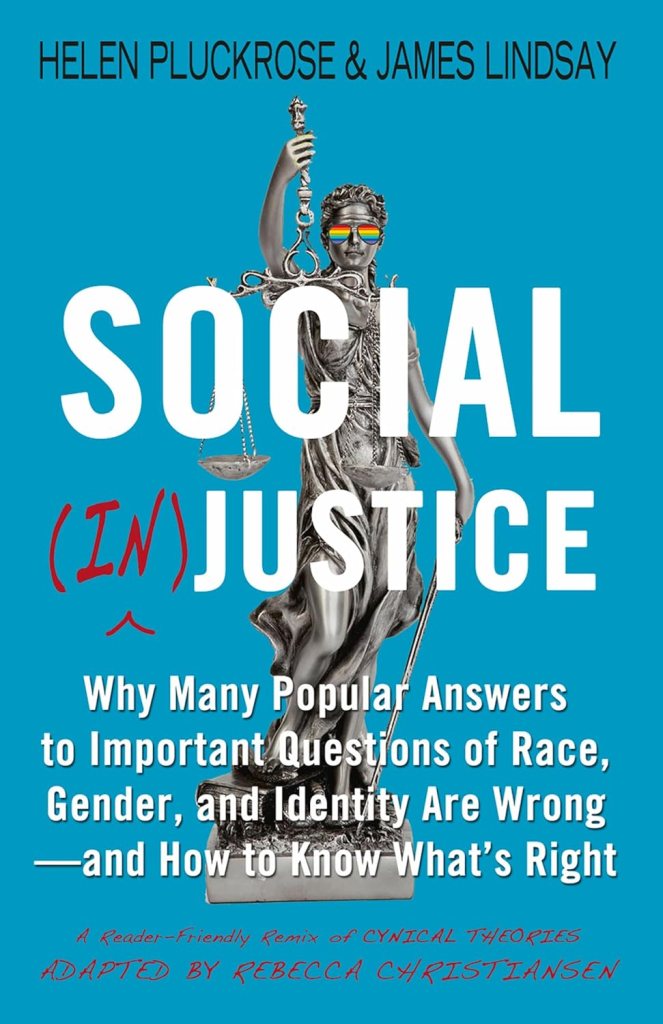
The essence of queer theory is that we are born without a gender identity and sex is something that is merely assigned at birth. According to queer theory, gender roles are performative and we can develop along lines that may differ from natal sex. For a more detailed and much better account, I recommend Helen Pluckrose and James Lindsay’s book Cynical Theories or the abbreviated version of that book ‘Social Injustice’ here. The book contains an account of how Gayle Rubin, Eve Kosofsky Sedgewick and Judith Butler built on the work of Foucault to develop queer theory. These should not be thought of as fringe academics; Michel Foucault and Judith Butler were the most cited academics in the Humanities and Social Sciences. Judith Butler got column inches in the Guardian where she described resistance to trans ideology as the last redoubt of fascism.
Public and political support for gender ideology has mostly come from women
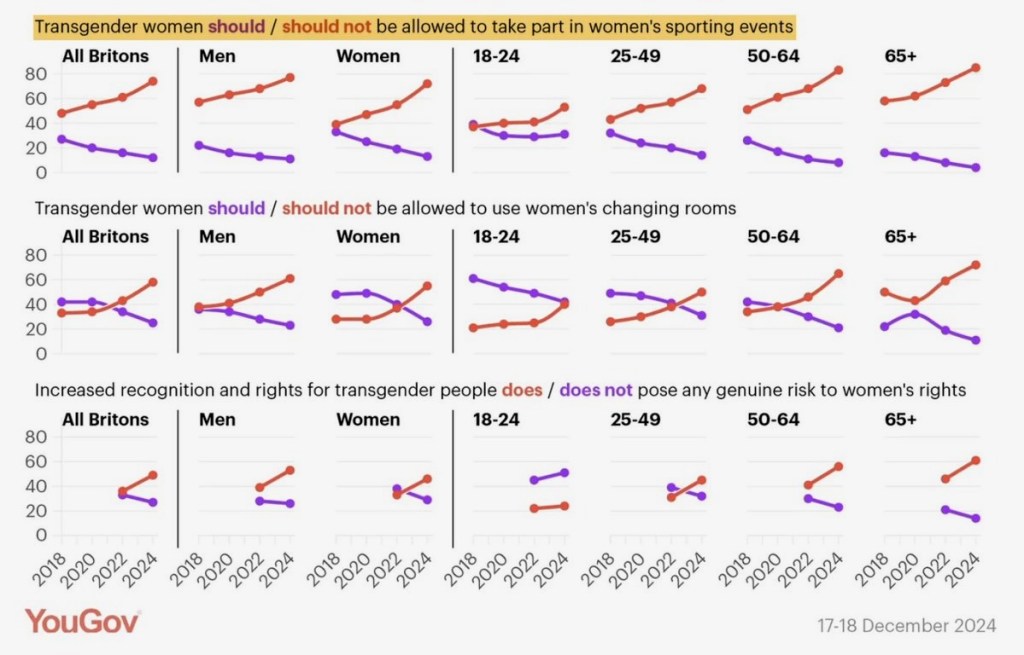
YouGov polls and the UK, US and Scandinavian countries have all shown the same pattern, that support for trans-ideology has mostly come from women, particularly young women. That even included ‘transgender women’ being allowed to participate in women’s sports. I find this remarkable and I wonder if men, in general, have more experience of contact sports and because of greater male variability, are more likely to have come up against someone much bigger and stronger and are aware of what that can entail. Or it may simply be that women are more likely to follow the crowd.
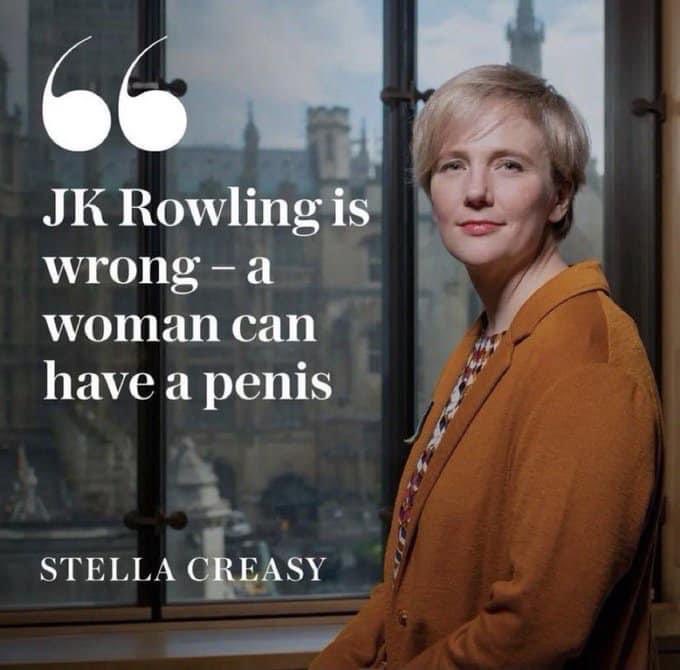
At the political level it was mostly female members of parliament pushing this ideology. To name a few, Stella Creasy, Zara Sultana, Angela Rayner, Nadia Whittome, Anneliese Dodds, Dawn Butler and Harriet Harman. Even safeguarding minister Jess Phillips got this colossally wrong when she argued that although trans-women were not biological women, they should be treated as such! Surely the worst of all worlds (here).
The Conservative Party wasn’t immune to this either; trans ideology flourished under their watch. Education Secretary Gillian Keegan argued that men who had undergone reassignment surgery were women. Or Alicia Kearns argued for retention of the T in LGBT. When Maria Miller was chair of the Women and Equalities Committee, they produced a report that backed self-ID and she argued that anyone who disagreed with the report must be a ‘feminist imposter’. Theresa May writing in Pink News promised to ‘streamline and de-medicalise’ the process of getting a gender recognition certificate. Carline Noaks MP and the committee stalwart also got this wrong (here). The list goes on and on and it is mostly female/feminist MPs.
The catalyst for the backlash came from the Scottish Parliament, where PM Nicola Sturgeon and Green MP Lorna Salter pushed for gender self-ID a policy that ultimately cost her job and her reputation.
At the political level trans-ideology was a movement suffused with toxic feminine and feminist energy. Because of the omertá of feminism. these characters are downplayed and instead they focus on the resistance of MP, Rosie Duffield.
The educational level
Trans ideology became embedded in the curricula of many schools. This happened by stealth and without the knowledge or consent of the public. Again, the pushers were mostly female. Take Professor Emma Renold who wrote the UNESCO approved ‘Agenda’ document for schools. Or Jessica Ringrose feminist sociologist at University College London, who was allowed into schools, possibly without the consent of parents, to, in her words,
‘introduce a series of images of high profile transgender, non-binary and feminist activists, including media celebrities. Matter-realising Judith Butler’s enduringly germane ‘gender trouble’, this second hour was pivotal in exploring how young people were navigating an increasingly visible ‘gender revolution’
More girls than boys
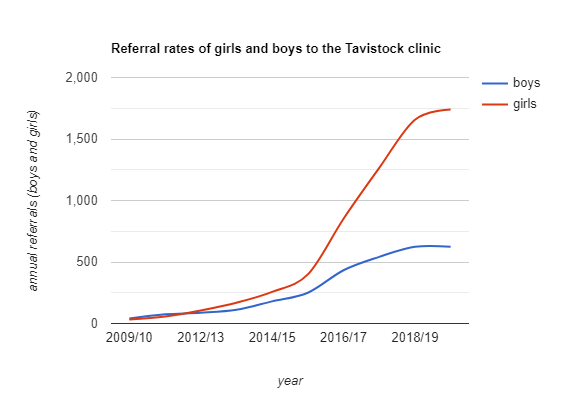
Contrary to the impression given by feminist activists, it was girls being referred to gender reassignment services, something that was true both in the UK and the US. I suspect this was because social contagion speeds more easily in female groups.
There are more transmen than transwomen; they may not pose a physical threat but it reveals the prevailing direction of the ideology.
Resistance to trans ideology has come from men as well as women
You might think that resistance has only come from brave and selfless women, figures such as Rosie Duffield, Helen Joyce and Kathleen Stock. This, however, is far from the case. The first figures to be shut down were male. Indeed, the prevailing belief was that women and only women are the experts on matters of gender, and men should just sit back and listen. When Jordan Peterson objected to the compelled use of pronouns, he was attacked by white liberal women including Cathy Newman and her fan-girls at the Guardian. When Graham Linehan (he has since become something of a monomaniac on the issue) challenged trans orthodoxy, all work with the BBC dried up. When James Esses who was studying on a psychotherapy course, argued that sex was binary and immutable he was expelled from his course (here). When evolutionary biologist Colin Wright, author of Realities Last Stand argued for the reality of biological sex he was denounced on university campuses. The list goes on, but these figures are rarely mentioned because feminists are trying to turn this issue into evidence of their oppression by men, which it most definitely is not.
Gamma Bias
This can be summed up as a form of our old friend – gamma bias.
Emphasise transwomen but no mention of the greater number of transmen.
Emphasise female resistance, de-emphasise male resistance.
De-emphasise female political support, emphasise male political support.


“In oversimplified form, this says that objective knowledge is not accessible to humans and whichever group has the most power (white men) gets their version of reality to be the accepted one;“
Remember that a society can stay centuries thinking something wrong (geocentrism for example).
The number of bridges that link social constructs to reality is not that great that you can necessarily force the truth. If what people think has no consequence on their everyday lives, some misguided theories can last long in the society. Religions are (for me) an example of misguided theories that last long in the society. So if some activists decide to enforce their very own idea of what should be the reality, they can certainly do it with enough power. The real question is more:
“Since we live in science‑based societies, where reason and critical thinking rely on a vision of the world that should be as accurate as possible (experience proven), should we let ideologists dictate what we should think simply because, with enough force, they can impose it? Is there any room for obscurantism in our society, and how can people who claim to be underdogs presume to tell us what to think?”
You seem to have knowledge of psychology, therefore you have to know the difference between science and a social construct. I think our feminists are just preparing a new dark age, where the witches (the bad women) have the role of the wise philosopher (hint: they are not).
LikeLike
Test
LikeLike
For me the biggest irony is how the trans activists not only took f*minists logic and used it against them, they also used their methods: trying to shame people who disagreed with them, calling them names to make it look like detractors were violent and bigoted, trying to get people ostracised for speaking out against them; these are all from the f*minist playbook.
Now they are the targets, many f*minists either don’t know how to deal with it, or they cry foul.
LikeLike
“Labelling” is a well-known technic of manipulation. You will find an article about that, for example on Wikipedia (there’s even 2 articles there). They just want to push their vision of the world. My problematic feminists were utterly manipulative. If you have to deal with them, they will basically do whatever they can to make you weak and sabotage your social life, making romantic relationships very difficult.
Ps: I absolutely don’t care about “incels”. The only solution for “incels” is to deal with it, at least it will keep them from looking miserable and prevent these devious people from laughing at them.
LikeLike